Familial isolated pituitary adenoma
अंतिम अद्यतन 18 Aug 2020
मरीज की संपादकीय दिशानिर्देशों
- डाउनलोडडाउनलोड
- साझा करें
- Language
- चर्चा
- Ask Patient
- ऑडियो संस्करण
- Google पर पसंदीदा स्रोतों में जोड़ें
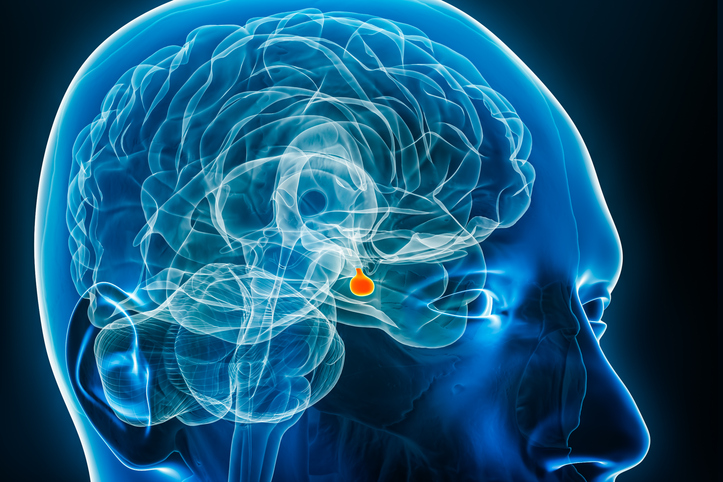
Familial isolated pituitary adenoma (FIPA) is an inherited condition characterised by development of a noncancerous tumour in the pituitary gland (called a pituitary adenoma). The pituitary gland, which is found at the base of the brain, produces hormones that control many important body functions.
के लिए वीडियो चयन आनुवंशिक स्थितियाँवीडियो लाइब्रेरी
विवरण
Familial isolated pituitary adenoma (FIPA) is an inherited condition characterised by development of a noncancerous tumour in the pituitary gland (called a pituitary adenoma). The pituitary gland, which is found at the base of the brain, produces hormones that control many important body functions.
Tumours that form in the pituitary gland can release excess levels of one or more hormones, although some tumours do not produce hormones (nonfunctioning pituitary adenomas). Those that do are typically distinguished by the particular hormones they produce. Prolactinomas are the most common tumours in FIPA. These tumours release prolactin, a hormone that stimulates breast milk production in females. Both women and men can develop prolactinomas, although they are more common in women. In women, these tumours may lead to changes in the menstrual cycle or difficulty becoming pregnant. Some affected women may produce breast milk, even though they are not pregnant or nursing. In men, prolactinomas may cause erectile dysfunction or decreased interest in sex. Rarely, affected men produce breast milk. Large prolactinomas can press on nearby tissues such as the nerves that carry information from the eyes to the brain (the optic nerves), causing problems with vision.
Another type of tumour called somatotropinoma is also common in FIPA. These tumours release growth hormone (also called somatotropin), which promotes growth of the body. Somatotropinomas in children or adolescents can lead to increased height (gigantism), because the long bones of their arms and legs are still growing. In adults, growth of the long bones has stopped, but the tumours can cause overgrowth of the hands, feet, and face (acromegaly) as well as other tissues.
Less common tumour types in FIPA include somatolactotropinomas, nonfunctioning pituitary adenomas, adrenocorticotropic hormone-secreting tumours (which cause a condition known as Cushing disease), thyrotropinomas, and gonadotropinomas. In a family with the condition, affected members can develop the same type of tumour (homogenous FIPA) or different types (heterogenous FIPA).
In FIPA, pituitary tumours usually occur at a younger age than sporadic pituitary adenomas, which are not inherited. In general, FIPA tumours are also larger than sporadic pituitary tumours. Often, people with FIPA have macroadenomas, which are tumours larger than 10 millimeters.
Familial pituitary adenomas can occur as one of many features in other inherited conditions such as multiple endocrine neoplasia type 1 and Carney complex; however, in FIPA, the pituitary adenomas are described as isolated because only the pituitary gland is affected.
Inheritance patterns
The source lists the following possible inheritance patterns: Autosomal dominant. More than one pattern can apply in different cases.
Related genes
Other names
FIPA
Related patient information and medicines

Patient information leaflet
हाइपरपैराथायरॉइडिज्म
Causes include: A single parathyroid adenoma. Primary hyperparathyroidism does not usually run in families. However, in a very small number of people, it can be the result of an inherited condition called familial isolated hyperparathyroidism. साथ ही, rarely, it may be विरासत में मिला के रूप में part of a collection of problems (a syndrome) called multiple.
Patient information leaflet
पिट्यूटरी ग्रंथि विकार
This leaflet gives a brief overview of the pituitary gland and the hormones it makes. Some of the pituitary gland disorders Pituitary disorders generally occur when the pituitary gland is either ... Often there is a discrete piece of pituitary gland which leads to the problems, this is called a pituitary adenoma (if it is large it may be called.

Patient information leaflet
कुशिंग सिंड्रोम
What causes Cushing's syndrome. There are a number of causes of Cushing's syndrome. These include the following: Pituitary adenoma - Cushing's disease A pituitary adenoma is a small, non-cancerous (benign) tumour in the pituitary gland. It is usually less than 1 cm in size और is made of abnormal cells which make lots of ACTH. The ACTH stimulates.

Patient information leaflet
एक्रोमेगली
What causes acromegaly. In nearly everyone with acromegaly, the excess hormone comes from a small growth (tumour) in the pituitary gland (a pea-sized gland below the brain). This is a non-cancerous (benign) growth called a pituitary adenoma. The adenoma may grow up to 1-2 cm across. The abnormal cells in the adenoma then make a lot of growth.

Patient information leaflet
अत्यधिक सक्रिय थायरॉयड ग्रंथि
What is hyperthyroidism. Neck cross-section showing the thyroid gland Cross section of neck showing the thyroid gland Hyperthyroidism means an overactive thyroid gland. Sometimes only one nodule forms. This is called a toxic solitary adenoma. This most commonly occurs in people aged between 30 and 50 years. One or both of the following may be.

Patient information leaflet
क्लस्टर सिरदर्द
ServiceUpsellPlaceholder What causes cluster headaches. There is also a genetic link with कुछ people (about 1 in 20 people with cluster headaches have another family member affected). Stro... In a very small minority of cases, cluster headaches seem to be triggered by a tumour in यह pituitary gland (pituitary adenoma) or other brain tumours..
अधिक पठन और संदर्भ
- Familial isolated pituitary adenoma; MedlinePlus, National Library of Medicine.
- Beckers A, Aaltonen LA, Daly AF, Karhu A. Familial isolated pituitary adenomas (FIPA) and the pituitary adenoma predisposition due to mutations in the aryl hydrocarbon receptor interacting protein (AIP) gene. Endocr Rev. 2013 Apr;34(2):239-77. doi: 10.1210/er.2012-1013. Epub 2013 Jan 31.
- Beckers A, Daly AF. The clinical, pathological, and genetic features of familial isolated pituitary adenomas. Eur J Endocrinol. 2007 Oct;157(4):371-82. doi: 10.1530/EJE-07-0348.
- Chahal HS, Chapple JP, Frohman LA, Grossman AB, Korbonits M. Clinical, genetic and molecular characterization of patients with familial isolated pituitary adenomas (FIPA). Trends Endocrinol Metab. 2010 Jul;21(7):419-27. doi: 10.1016/j.tem.2010.02.007. Epub 2010 Jun 1.
- Daly AF, Jaffrain-Rea ML, Ciccarelli A, Valdes-Socin H, Rohmer V, Tamburrano G, Borson-Chazot C, Estour B, Ciccarelli E, Brue T, Ferolla P, Emy P, Colao A, De Menis E, Lecomte P, Penfornis F, Delemer B, Bertherat J, Wemeau JL, De Herder W, Archambeaud F, Stevenaert A, Calender A, Murat A, Cavagnini F, Beckers A. Clinical characterization of familial isolated pituitary adenomas. J Clin Endocrinol Metab. 2006 Sep;91(9):3316-23. doi: 10.1210/jc.2005-2671. Epub 2006 Jun 20.
- Daly AF, Rixhon M, Adam C, Dempegioti A, Tichomirowa MA, Beckers A. High prevalence of pituitary adenomas: a cross-sectional study in the province of Liege, Belgium. J Clin Endocrinol Metab. 2006 Dec;91(12):4769-75. doi: 10.1210/jc.2006-1668. Epub 2006 Sep 12.
- Leontiou CA, Gueorguiev M, van der Spuy J, Quinton R, Lolli F, Hassan S, Chahal HS, Igreja SC, Jordan S, Rowe J, Stolbrink M, Christian HC, Wray J, Bishop-Bailey D, Berney DM, Wass JA, Popovic V, Ribeiro-Oliveira A Jr, Gadelha MR, Monson JP, Akker SA, Davis JR, Clayton RN, Yoshimoto K, Iwata T, Matsuno A, Eguchi K, Musat M, Flanagan D, Peters G, Bolger GB, Chapple JP, Frohman LA, Grossman AB, Korbonits M. The role of the aryl hydrocarbon receptor-interacting protein gene in familial and sporadic pituitary adenomas. J Clin Endocrinol Metab. 2008 Jun;93(6):2390-401. doi: 10.1210/jc.2007-2611. Epub 2008 Apr 1.
- Vierimaa O, Georgitsi M, Lehtonen R, Vahteristo P, Kokko A, Raitila A, Tuppurainen K, Ebeling TM, Salmela PI, Paschke R, Gundogdu S, De Menis E, Makinen MJ, Launonen V, Karhu A, Aaltonen LA. Pituitary adenoma predisposition caused by germline mutations in the AIP gene. Science. 2006 May 26;312(5777):1228-30. doi: 10.1126/science.1126100.
हमारे में दूसरों के साथ अपने विचार या अनुभव साझा करें रोगी समुदायों.
ऑनलाइन विश्वसनीय उपचार और स्वास्थ्य सेवाओं तक सरल पहुंच।.
Common conditions
Get help with common conditions through the NHS, without a GP appointment.





पेशेंट न्यूज़लेटर के लिए साइन अप करें
आपकी साप्ताहिक खुराक स्पष्ट, विश्वसनीय स्वास्थ्य सलाह की - जो आपको सूचित, आत्मविश्वासी और नियंत्रण में महसूस करने में मदद करने के लिए लिखी गई है।.
सदस्यता लेने पर आप हमारी स्वीकार करते हैं गोपनीयता नीति. आप किसी भी समय सदस्यता समाप्त कर सकते हैं। हम कभी भी आपका डेटा नहीं बेचते।.