Nappy rash
Peer reviewed by Dr Philippa Vincent, MRCGPLast updated by Dr Rachel Hudson, MRCGPLast updated 16 May 2023
Meets Patient’s editorial guidelines
- DownloadDownload
- Share
- Language
- Discussion
- Audio Version
- Add to preferred sources on Google
Most babies develop a nappy rash at some stage. Usually it is mild and does not bother your baby. However, it can be more severe and sore in some cases. It can usually be managed with the suggestions below.
At a glance
Nappy rash is a common skin inflammation in babies, often caused by urine and poo irritating sensitive skin.
A germ called candida, which causes thrush, can make the rash brighter red.
Teething can worsen nappy rash, possibly due to changes in a baby's poo.
To help prevent nappy rash, leave the nappy off when possible and change it often.
Use fragrance-free, alcohol-free wipes and dry your baby's bottom thoroughly after washing.
Barrier creams like zinc and castor oil ointment can protect the skin.
Do not use talcum powder, soaps, bubble baths, lotions, or tight plastic pants.
See your doctor if nappy rash does not improve with usual treatments.
What causes nappy rash?
Nappy rash is a skin inflammation. Most cases are due to a reaction of the skin to urine and poo. Babies have sensitive skin which is vulnerable to irritation.
Nappy rash
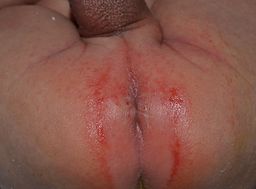
© Dailyboth, CC0, via Wikimedia Commons
In addition, a germ called candida commonly thrives on the inflamed skin. (This is the germ that also causes the infection commonly known as thrush which most often occurs in the mouth (oral thrush) or around the genital area.) Candida can cause a more inflamed rash which is a brighter or darker red. Sometimes the rash can also become infected with other types of germs called bacteria. This will also make the rash more red and sore.
Nappy rash candida
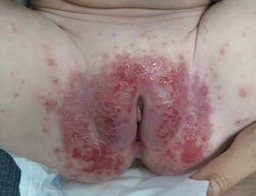
© Elaine C. Siegfried1,†* and Adelaide A. Hebert2,†, CC BY 4.0, via Wikimedia Commons
Nappy rash can occur or worsen when your baby is teething. It is unclear why teething can lead to nappy rash although it is thought that it is due to your baby producing more saliva. This changes the nature of the baby's poo, making it more likely to cause a reaction when it touches the skin.
Most nappy rashes are mild or moderate and are not serious. Occasionally, skin conditions such as eczema, psoriasis, infections and some rare skin diseases cause unusual nappy rashes.
How can I heal or prevent nappy rash?
Leave the nappy off as much as possible
This allows fresh air to get to the skin. Obviously, you cannot leave the nappy off all the time. However, the more fresh air, the better. Try letting the baby lie without a nappy on a towel or disposable absorbent sheet for a period of time each day. However, do change the towel or sheet as soon as it becomes wet.
Change the nappy often
Ideally, change the nappy as soon as it is wet or soiled. The aim is to prevent your baby's skin being in contact with urine and poo (faeces) for long periods of time. This is especially important if your baby is teething and has offensive, runny poo.
Wipes are as effective as water
Studies have shown that using baby wipes has the same effect on your baby's skin as using cotton wool and water. However, it is best to use wipes which are free from fragrance or alcohol.
After washing, make sure the baby's bottom is properly dry
Do this before putting on a new nappy. Dry by patting, not by rubbing, with a towel.
Do not use powder such as talcum powder
This may irritate the skin. Also avoid soaps, bubble baths and lotions.
Use barrier creams or ointments
Available to buy from pharmacies, barrier creams or ointments may help to protect the skin from moisture. They literally form a barrier between your baby's skin and the poo or urine. Ideally, rub on a thin layer of barrier cream or ointment just before putting on each nappy. Do not apply too much, as this may reduce the 'breathability' of the nappy. The recommended ointments are:
Zinc and castor oil ointment.
Metanium®.
White soft paraffin ointment.
Bepanthem® ointment.
Don't use tight-fitting plastic pants over nappies
They keep in moisture and may make things worse.
What other treatments may be used?
The above measures are likely to clear a mild rash. If the rash becomes worse, a healthcare professional may advise using one of the following in addition to the above measures:
A mild steroid cream or ointment such as hydrocortisone can be used to treat nappy rash. Steroids treat inflammation. Apply sparingly as often as prescribed (before using a barrier cream or ointment) for a few days until the rash has cleared. A steroid cream or ointment should not usually be used for more than seven days.
An antifungal cream which kills thrush (candida). This is typically applied 2-3 times a day. Unlike a steroid cream, continue to use an antifungal cream for 7-10 days after the rash has cleared, to make sure all the candidal germs have gone. If you are prescribed an antifungal cream, use this without a barrier cream. In this way you clear up the infection first. THEN use the barrier cream to help clear up the nappy rash.
A combination cream containing an antifungal agent and a mild steroid is often given.
Sometimes the inflamed skin of a nappy rash becomes infected with other types of germs (bacteria). This may be suspected if the rash becomes worse, despite use of the above treatments. In these cases an antibiotic medicine may be needed.
Also, as mentioned, occasionally a nappy rash is due to an unusual or more serious skin condition. Therefore, if a nappy rash does not improve with the usual treatment described above then see your doctor.
Patient picks for Baby and toddler
Children's health
Blocked nose in babies
It is common for babies aged under 6 months to have a blocked nose (commonly called 'snuffles'). It is usually due to normal mucus that collects in the nose, which is difficult for the baby to clear. No treatment is required if the baby is otherwise well and feeding well.
by Dr Hayley Willacy, FRCGP

Children's health
Treating newborn health problems
Treatment depends on the problem, but the conditions being screened for are all ones for which there is a treatment if they are picked up.
by Dr Mary Harding, MRCGP
Frequently asked questions
Can I use cloth nappies if my baby has nappy rash?
The article suggests leaving the nappy off as much as possible to allow air to circulate and changing nappies frequently. It also recommends avoiding tight-fitting plastic pants that can trap moisture. While it doesn't directly address cloth nappies, these principles suggest that breathable options and frequent changes would be beneficial.
How can I tell if my baby's nappy rash has become infected with bacteria?
The article states that if the inflamed skin of a nappy rash becomes infected with bacteria, it may be suspected if the rash worsens despite using typical treatments. In such cases, an antibiotic medicine might be necessary.
At what point should I be concerned that my baby's nappy rash isn't just a common rash?
If a nappy rash does not improve with the usual treatment measures described, or if it is suspected to be due to an unusual or more serious skin condition like eczema, psoriasis, or rare skin diseases, then it is advised to see a doctor.
After using an antifungal cream for thrush, when should I start using a barrier cream again?
If you are prescribed an antifungal cream, you should use it without a barrier cream first to clear up the infection. Once the infection is cleared, you can then start using a barrier cream to help manage the nappy rash.
Further reading and references
- Napkin dermatitis; DermNet NZ
- Blume-Peytavi U, Lavender T, Jenerowicz D, et al; Recommendations from a European Roundtable Meeting on Best Practice Healthy Infant Skin Care. Pediatr Dermatol. 2016 May;33(3):311-21. doi: 10.1111/pde.12819. Epub 2016 Feb 26.
- Nappy rash; NICE CKS, July 2022 (UK access only)
About the authorView full bio

Dr Rachel Hudson, MRCGP
General Practitioner and Medical Author
MBChB, MRCGP (2008), BSc (Medical Science), DFSRH, DRCOG, DCH
Dr Rachel Hudson, is an NHS GP working in the North West of England.
About the reviewerView full bio

Dr Philippa Vincent, MRCGP
General Practitioner, Medical Author
MB BS, Bsc, MRCGP (2000), DCH, DFSRH, DRCOG
Dr Philippa Vincent is an NHS GP working in North London.
Article history
The information on this page is written and peer reviewed by qualified clinicians.
Article also available in English, German, Spanish, French, Italian, Portuguese, Hindi, Hebrew, Arabic, and Swedish.
Next review due: 14 May 2028
16 May 2023 | Latest version
Join the conversation
Share your thoughts or experiences with others in our patient communities.

Ask, share, connect.
Browse discussions, ask questions, and share experiences across hundreds of health topics.

Feeling unwell?
Assess your symptoms online for free
Sign up to the Patient newsletter
Your weekly dose of clear, trustworthy health advice - written to help you feel informed, confident and in control.
By subscribing you accept our Privacy Policy. You can unsubscribe at any time. We never sell your data.
More in children's health
- Bedwetting medicine - desmopressin
- Bedwetting reward systems
- Breastfeeding your baby
- Bronchiolitis
- Bullying
- Cot death
- Diabetes in children
- Feeding your toddler
- Intraventricular haemorrhage in babies
- Klinefelter's syndrome
- Pneumococcal immunisation
- Polio and polio vaccine
- Retinopathy of prematurity
- Roseola
- Rubella
- Tetanus and the tetanus vaccine
- Turner syndrome
- Undescended testicles