Laparoscopy and laparoscopic surgery
द्वारा सहकर्मी समीक्षा की गई डॉ राचेल हडसन, एमआरसीजीपीद्वारा अंतिम अपडेट Dr Caroline Wiggins, MRCGP अंतिम अद्यतन 7 Aug 2023
मरीज की संपादकीय दिशानिर्देशों
- डाउनलोडडाउनलोड
- साझा करें
- Language
- चर्चा
- ऑडियो संस्करण
- Google पर पसंदीदा स्रोतों में जोड़ें
Laparoscopy is a surgical procedure which uses a special surgical instrument called a laparoscope to look inside the body or to perform certain operations.
एक नजर में
A laparoscopy uses a thin telescope with a light to look inside your tummy.
Laparoscopic surgery, also called keyhole surgery, uses small cuts to perform operations.
It can be used to diagnose conditions or perform procedures like removing a gallbladder.
Compared to traditional surgery, it usually causes less pain and has a quicker recovery.
You will typically be asleep under general anaesthesia for the procedure.
Recovery time varies depending on the procedure and you may have shoulder tip pain.
Seek medical advice if you experience concerning symptoms after the surgery.
When compared with traditional surgery, laparoscopic surgery usually has:
Less pain following the procedure.
Lower risk of complications.
A shorter hospital stay and a quicker recovery.
A much smaller scar.
नोट: नीचे दी गई जानकारी केवल एक सामान्य मार्गदर्शिका है। व्यवस्थाएँ और परीक्षण करने का तरीका विभिन्न अस्पतालों के बीच भिन्न हो सकता है। हमेशा अपने डॉक्टर या स्थानीय अस्पताल द्वारा दिए गए निर्देशों का पालन करें।.
What is a laparoscopy?
Laparoscopy is a procedure to look inside your tummy (abdomen) by using a laparoscope. A laparoscope is like a thin telescope with a light source. It is used to light up and magnify the structures inside the abdomen. A laparoscope is passed into the abdomen through a small cut in the skin.
What is laparoscopic surgery?
As well as simply looking inside (laparoscopy), a doctor can use fine instruments to operate (laparoscopic surgery). These are passed into the tummy (abdomen) through another small cut in the skin. These instruments are used to cut or trim tissues, perform biopsies, grasp organs, etc, inside the abdomen. This laparoscopic surgery is sometimes called 'keyhole surgery' or 'minimally invasive surgery'.
Laparoscopic surgery
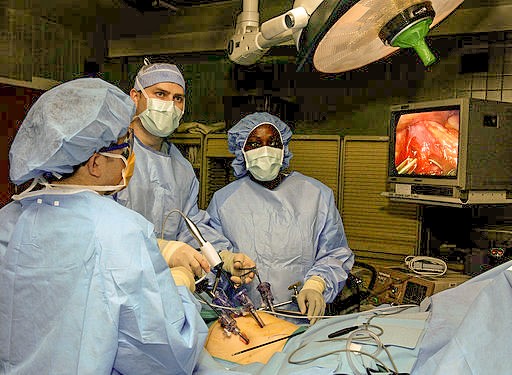
© By Samuel Bendet, US Air Force, via Wikimedia Commons
Why is laparoscopic surgery done?
A laparoscopy may be done to find the cause of symptoms such as abdominal pain, pelvic pain or swelling of the abdomen or pelvic region. A laparoscopy enables a doctor to see clearly inside your abdomen. This enables certain conditions to be diagnosed eg, endometriosis.
Laparoscopic surgery can be used for various procedures which include:
Removal of the gallbladder. This is sometimes called a laparoscopic cholecystectomy, or 'lap choly', for short. It is now the most common way for a gallbladder to be removed, usually for पित्ताशय की पथरी which are causing pain.
Removal of the appendix.
Removal of areas of एंडोमेट्रियोसिस.
Removal of parts of the intestines.
Treating अस्थानिक गर्भावस्था.
Taking a biopsy of tissues inside the abdomen.
How is laparoscopy done?
Laparoscopy and laparoscopic surgery are usually done whilst you are asleep under general anaesthesia. The skin over the tummy is cleaned.
In a laparoscopy, the surgeon makes a small cut about 0.5-2 cm long near to the belly button. Some gas is injected through the cut to inflate the abdomen slightly. This makes it easier to see the internal organs with the laparoscope which is gently pushed through the incision into the abdominal cavity. The operator then looks down the laparoscope, or looks at pictures on a TV monitor connected to the laparoscope.
If you have a surgical procedure, one or more separate small incisions may be made in the abdominal skin. These allow thin instruments to be pushed into the abdominal cavity. The surgeon can see the ends of these instruments with the laparoscope and so can perform procedures.
A more recent technique called single-port laparoscopy involves operating through the same incision through which the laparoscope was passed and does not require additional cuts to the abdomen.
When the surgeon has finished, the laparoscope and other instruments are removed. The incisions are stitched and dressings are applied. The dressings will cover the incisions and should be kept on until the incisions have healed.
What preparation might I need?
As you will usually be under a general anaesthetic, your hospital should give you instructions about not eating or drinking before the operation.
Depending on the reason for your operation or what medication you normally take, there may be other, more specific instructions. Your doctor will give you this information if necessary.
Laparoscopy recovery
The length of time to recover can vary. It depends on why the procedure was done and what operations were performed. A simple investigation to 'look around' will leave you a little uncomfortable for a few days.
You may need a day or up to a week to feel completely well after the general anaesthetic. You may take longer to feel well if you were under anaesthetic for a long time. Before you leave the hospital you will be given advice about recovering after anaesthesia. This should include information about driving.
You are able to eat and drink as normal after laparoscopy. You may have some pain in your shoulder tip. This is caused by the gas that was pumped inside. It can irritate your diaphragm which has the same nerve supply as the shoulder tip and makes it feel as though your shoulder hurts. This should soon wear off.
What are other possible complications?
There may be some minor bleeding or bruising around the skin incisions. In most cases there are no complications. Before the operation your surgeon will discuss the possible complications with you so you understand the risks involved.
Possible complications of laparoscopy include:
Accidental damage to structures inside your tummy (abdomen), such as the intestines or blood vessels. This is rare but if it occurs, an emergency traditional (open) operation may be needed.
As with any operation, there is a small risk of complications of anaesthesia.
Occasionally the incisions become infected which may require a course of एंटीबायोटिक्स.
If you have laparoscopic surgery (rather than only a laparoscopy), the risk of complications may increase depending on what operation is performed. Before leaving hospital you will be given information about what symptoms should prompt you to seek medical advice (in case they are a complication of the surgery) and who to contact.
The key advantages of laparoscopic surgery are the quicker recovery times and reduced need for pain relief, compared to traditional (open) surgery.
When compared with traditional surgery, laparoscopic surgery usually has:
Less pain following the procedure.
Lower risk of complications.
A shorter hospital stay and a quicker recovery.
A much smaller scar.
नोट: नीचे दी गई जानकारी केवल एक सामान्य मार्गदर्शिका है। व्यवस्थाएँ और परीक्षण करने का तरीका विभिन्न अस्पतालों के बीच भिन्न हो सकता है। हमेशा अपने डॉक्टर या स्थानीय अस्पताल द्वारा दिए गए निर्देशों का पालन करें।.
रोगी के लिए चयन सामान्य सर्जरी और प्रक्रियाएँ

सर्जरी और प्रक्रियाएँ
मेनोरेजिया सर्जरी
Heavy periods are common. In most cases no cause can be found. In some cases a cause is found such as endometriosis or fibroids. In most cases treatment is effective by using medication or an intrauterine system (IUS) to reduce bleeding. However, some women will require surgery. The different types of surgery available will be discussed here.
डॉ. कॉलिन टिडी, MRCGP द्वारा

सर्जरी और प्रक्रियाएँ
आर्थ्रोस्कोपी और आर्थ्रोस्कोपिक सर्जरी
आर्थ्रोस्कोपी एक शल्य प्रक्रिया है जिसमें एक पतले दूरबीन का उपयोग किया जाता है जिसमें एक प्रकाश स्रोत (आर्थ्रोस्कोप) होता है, जो जोड़ों के अंदर देखने के लिए होता है। अंदर देखने के अलावा, सर्जन आर्थ्रोस्कोप का उपयोग कीहोल सर्जरी करने के लिए भी कर सकता है। आर्थ्रोस्कोपी का सबसे अधिक उपयोग घुटने की समस्याओं की जांच या उपचार के लिए किया जाता है। आर्थ्रोस्कोपी का उपयोग अन्य जोड़ों के लिए भी किया जा सकता है, जिसमें कंधा, कूल्हा, कोहनी, कलाई और टखने के जोड़ शामिल हैं, और यहां तक कि हाथ या पैर की समस्याओं के लिए भी। नोट: नीचे दी गई जानकारी केवल एक सामान्य मार्गदर्शिका है। व्यवस्थाएं, और परीक्षण किए जाने का तरीका, विभिन्न अस्पतालों के बीच भिन्न हो सकते हैं। हमेशा अपने डॉक्टर या स्थानीय अस्पताल द्वारा दिए गए निर्देशों का पालन करें।.
डॉ. राचेल हडसन, MRCGP द्वारा
अक्सर पूछे जाने वाले प्रश्न
What is the difference between laparoscopy and laparoscopic surgery?
Laparoscopy is a procedure where a thin telescope with a light source (laparoscope) is inserted into the abdomen through a small cut to simply look inside and diagnose conditions. Laparoscopic surgery, also known as 'keyhole surgery' or 'minimally invasive surgery,' uses additional fine instruments passed through other small cuts to perform operations like cutting tissues, taking biopsies, or removing organs.
What is 'single-port laparoscopy'?
Single-port laparoscopy is a newer technique where both the laparoscope and the surgical instruments are inserted through the same incision. This means that no additional cuts to the abdomen are required beyond the initial one.
How long does a laparoscopy procedure take?
The article states that recovery can vary depending on the procedure, but it does not specify how long the actual procedure itself takes.
अधिक पठन और संदर्भ
- Rao PP, Rao PP, Bhagwat S; Single-incision laparoscopic surgery - current status and controversies. J Minim Access Surg. 2011 Jan;7(1):6-16. doi: 10.4103/0972-9941.72360.
- Rockall TA, Demartines N; Laparoscopy in the era of enhanced recovery. Best Pract Res Clin Gastroenterol. 2014 Feb;28(1):133-42. doi: 10.1016/j.bpg.2013.11.001. Epub 2013 Dec 1.
लेखक के बारे मेंपूरा जीवन परिचय देखें

Dr Caroline Wiggins, MRCGP
सामान्य चिकित्सक, चिकित्सा लेखक
एमबीबीएस ऑनर्स (विशेष योग्यता के साथ), एमआरसीजीपी (2016), एमएससी.एसईएम (विशेष योग्यता के साथ), बीएससी (ऑनर्स)
डॉ कैरोलीन विगिन्स वर्तमान में इंग्लैंड के दक्षिण-पश्चिम में एक जीपी लोकम हैं।.
समीक्षक के बारे मेंपूरा जीवन परिचय देखें

डॉ राचेल हडसन, एमआरसीजीपी
सामान्य चिकित्सक और चिकित्सा लेखक
MBChB, MRCGP (2008), BSc (Medical Science), DFSRH, DRCOG, DCH
डॉ राचेल हडसन, इंग्लैंड के उत्तर पश्चिम में एनएचएस जीपी के रूप में काम कर रही हैं।.
लेख का इतिहास
इस पृष्ठ पर दी गई जानकारी योग्य चिकित्सकों द्वारा लिखी और सहकर्मी समीक्षा की गई है।.
लेख इन भाषाओं में भी उपलब्ध है अंग्रेज़ी, जर्मन, स्पेनिश, फ्रेंच, इतालवी, पुर्तगाली, हिंदी, हिब्रू, अरबी, और स्वीडिश.
Next review due: 5 Aug 2028
7 Aug 2023 | नवीनतम संस्करण

पूछें, साझा करें, जुड़ें।.
चर्चाओं को ब्राउज़ करें, प्रश्न पूछें, और सैकड़ों स्वास्थ्य विषयों पर अनुभव साझा करें।.

अस्वस्थ महसूस कर रहे हैं?
अपने लक्षणों का ऑनलाइन मुफ्त में मूल्यांकन करें
पेशेंट न्यूज़लेटर के लिए साइन अप करें
आपकी साप्ताहिक खुराक स्पष्ट, विश्वसनीय स्वास्थ्य सलाह की - जो आपको सूचित, आत्मविश्वासी और नियंत्रण में महसूस करने में मदद करने के लिए लिखी गई है।.
सदस्यता लेने पर आप हमारी स्वीकार करते हैं गोपनीयता नीति. आप किसी भी समय सदस्यता समाप्त कर सकते हैं। हम कभी भी आपका डेटा नहीं बेचते।.
सर्जरी और प्रक्रियाओं में अधिक
- कूल्हे या घुटने के प्रतिस्थापन के लिए एनेस्थेटिक
- आर्थ्रोस्कोपी और आर्थ्रोस्कोपिक सर्जरी
- बायोप्सी
- बोटॉक्स
- स्तन वृद्धि
- स्तन कमी
- कोलोनोस्कोपी
- गहरी शिरा घनास्रता
- ERCP
- चेहरे की सर्जरी
- बुखार
- गैस्ट्रोस्कोपी
- लेज़र आँख की सर्जरी
- लेज़र हेयर रिमूवल
- होंठों का सुधार
- यकृत बायोप्सी
- पेट की चर्बी हटाना
- नसबंदी
- वीडियो-सहायता प्राप्त थोराकोस्कोपिक सर्जरी
- वजन घटाने की सर्जरी