कोरोनरी आर्टरी बाईपास ग्राफ्ट
द्वारा सहकर्मी समीक्षा की गई Dr Colin Tidy, MRCGPद्वारा अंतिम अपडेट Dr Doug McKechnie, MRCGPअंतिम अद्यतन 7 मार्च 2025
मरीज की संपादकीय दिशानिर्देशों
- डाउनलोडडाउनलोड
- साझा करें
- Language
- चर्चा
- Ask Patient
- ऑडियो संस्करण
- Google पर पसंदीदा स्रोतों में जोड़ें
Coronary artery bypass grafting (CABG) is a type of heart surgery to treat coronary artery disease. The standard surgery requires open heart surgery and stopping of the heart temporarily.
एक नजर में
Coronary artery bypass graft (CABG) is a heart operation for coronary artery disease.
It diverts blood around narrowed or blocked heart arteries.
CABG is considered if medicines don't control angina or after a heart attack.
A coronary angiogram is done before surgery to check your arteries.
Most people are discharged about five days after uncomplicated surgery.
Preventing further heart disease involves lifestyle changes and medicines.
Coronary artery bypass grafting, called CABG for short (pronounced 'cabbage'), is a heart operation. It is also called coronary artery bypass surgery.
A CABG is used to treat coronary artery disease. In coronary artery disease, the arteries supplying the heart become narrowed and blocked, affecting blood flow to the heart. A CABG is an operation which diverts blood around a narrowed or blocked artery.
CABG procedures are a type of major heart surgery. They are usually done in people who have एनजाइना that isn't treated well enough with medicines, and in some people who have had a दिल का दौरा.
The aim of the surgery is to improve blood flow to the heart. This can improve symptoms of angina, and may reduce the risk of having a heart attack in future. In some cases, this can be life-saving.
Heart triple bypass
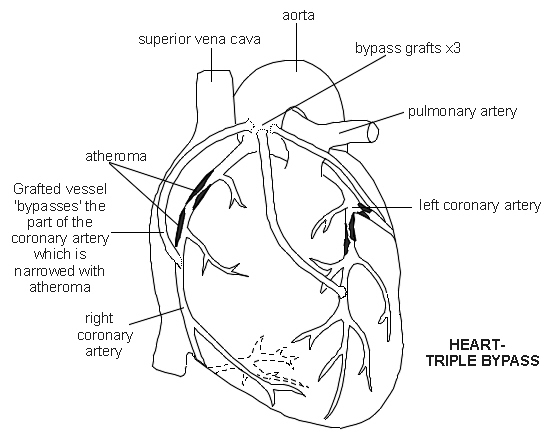
Before a CABG is offered, you will have a coronary angiogram. This is a technique for taking special X-rays. A small tube (catheter) is inserted via your wrist or groin and dye is injected to look at your arteries in greater detail. The procedure is used to look for the location and amount of narrowing in the coronary arteries.
A different procedure - angioplasty and stenting (percutaneous coronary intervention, or PCI) - is usually preferred for treating coronary artery disease because it has fewer risks and a much quicker recovery time.
However, a CABG is recommended in some situations, such as:
If PCI hasn't worked.
If there is a narrowing or blockage in the left main coronary artery - a large artery which provides blood supply to the left side of the heart.
If there is significant narrowing or blockage in several different coronary arteries.
If the left side of the heart is not pumping blood properly.
If someone has मधुमेह.
Cases are usually discussed at a cardiac multidisciplinary team meeting, which consists of cardiologists, anaesthetists, cardiac nurses and cardiac surgeons. Other illnesses you have and surgical risk will also be discussed and be important in deciding on whether surgery is the right approach.
Some people, particularly people who have had a recent heart attack, may need a hospital stay to wait for urgent surgery.
Coronary artery bypass graft procedure
You will be anaesthetised with a general anaesthetic (fully asleep).
A mid-sternal incision (vertical incision through the breastbone) is made.
The grafts are commonly taken from your leg veins. Sometimes, a graft may be taken from the internal mammary artery, an artery that runs inside the chest.
Most people will need three or more grafts (common terms used are 'triple bypass' and 'quadruple bypass').
During a CABG procedure, your heart and lungs are temporary stopped and the blood bypassed through a heart-lung bypass machine to allow the grafts to be stitched in place:
A technique using a smaller incision has also been used - called minimally invasive direct coronary artery bypass (MIDCAB); however, it is only appropriate for certain cases and is not routinely available.
Operating without bypass is possible but CABG with temporary bypass is the standard.
You will usually need to be on the intensive care unit for 24 hours after the procedure.
You will usually have a chest drain inserted - a tube draining fluid from around the lungs. This will usually be removed 2-3 days later. You will also have a urinary catheter.
People can be ready for discharge after five days provided no complications occur.
परिणाम
CABG improves symptoms of angina, quality of life and exercise capacity.
Around 10% of people will need a repeat CABG procedure after 10 years.
The chance of needing repeat surgery can be lessened by controlling the development of heart disease. This means धूम्रपान छोड़ना, lowering blood pressure and कोलेस्ट्रॉल स्तर and controlling diabetes mellitus.
जटिलताएँ
तीव्र गुर्दा चोट- kidney problems.
Ventricular arrhythmias - abnormal heart rhythms which can sometimes be serious.
Blood clots developing in the legs (डीप वेन थ्रॉम्बोसिस) or lungs (फुफ्फुसीय एम्बोलिज्म).
स्ट्रोक occurs in 1-2%. An ultrasound scan of the neck arteries is sometimes done before the operation. In some people with significant 'furring' (plaque disease) of the main neck vessels, carotid artery revascularisation surgery at the same time as a CABG procedure may be performed.
Cognitive decline following CABG surgery has been reported in various studies. Most changes are mild and thought to reverse within the first few months after the operation.
Localised infection at the site of veins taken from the legs.
What follow-up is needed after coronary artery bypass graft?
There will be surgical follow-up after discharge and then ongoing care with your doctor unless there are complications. Most people will be referred on to cardiac rehabilitation.
Prevention of coronary heart disease is very important and will include:
धूम्रपान छोड़ना।.
Use of long-term aspirin.
Use of an angiotensin-converting enzyme (ACE) inhibitor or an angiotensin-II receptor antagonist (AIIRA) - also called an angiotensin receptor blocker.
Use of beta-blockers.
Use of statins to achieve target cholesterol levels.
Control of blood pressure and diabetes mellitus.
Exercise and a healthy diet.
रोगी के लिए चयन सामान्य सर्जरी और प्रक्रियाएँ

सर्जरी और प्रक्रियाएँ
वीडियो-सहायता प्राप्त थोराकोस्कोपिक सर्जरी
वीडियो-सहायता प्राप्त थोराकोस्कोपिक सर्जरी (VATS) एक शल्य प्रक्रिया है जो डॉक्टरों को छाती और फेफड़ों के अंदर देखने की अनुमति देती है। यह 'कीहोल' सर्जरी का एक रूप है जिसका उपयोग विभिन्न शल्य प्रक्रियाओं को करने के लिए किया जा सकता है। नोट: नीचे दी गई जानकारी केवल एक सामान्य मार्गदर्शिका है। व्यवस्थाएं, और परीक्षण किए जाने का तरीका, विभिन्न अस्पतालों के बीच भिन्न हो सकते हैं। हमेशा अपने डॉक्टर या स्थानीय अस्पताल द्वारा दिए गए निर्देशों का पालन करें।.
डॉ लॉरेंस नॉट द्वारा
सर्जरी और प्रक्रियाएँ
कोलपोस्कोपी और गर्भाशय ग्रीवा के उपचार
कोलपोस्कोपी गर्भाशय ग्रीवा (सर्विक्स) की विस्तृत जांच है। इसे आमतौर पर एक कोलपोस्कोपी क्लिनिक में डॉक्टर या विशेषज्ञ नर्स द्वारा किया जाता है।.
डॉ. फिलिपा विंसेंट, MRCGP द्वारा
अक्सर पूछे जाने वाले प्रश्न
When is CABG surgery considered over an angioplasty and stenting (PCI)?
A different procedure, angioplasty and stenting (PCI), is usually preferred due to fewer risks and a quicker recovery. However, CABG might be recommended if PCI hasn't worked, if there's a blockage in the left main coronary artery or multiple arteries, if the left side of the heart isn't pumping properly, or if the patient has diabetes.
What happens before a CABG operation is confirmed?
Before surgery is offered, you will have a coronary angiogram to pinpoint blockages. Your case will be discussed by a cardiac multidisciplinary team, including cardiologists and surgeons. They will also consider any other illnesses and your overall surgical risk to decide if CABG is the right approach.
How long is the typical hospital stay after a CABG procedure?
You will usually be in the intensive care unit for 24 hours immediately after the procedure. Most people can be ready to go home after about five days, provided there are no complications during their recovery.
What is involved in the recovery process immediately after CABG?
Immediately after surgery, you'll be in intensive care for 24 hours. You'll likely have a chest drain to remove fluid, which is typically removed after 2-3 days, and a urinary catheter. People can often be discharged after five days if there are no complications.
What does a 'triple bypass' or 'quadruple bypass' mean?
These terms refer to the number of grafts used during the CABG procedure. A 'triple bypass' means three new pathways have been created to bypass blocked arteries, and a 'quadruple bypass' means four. Most people require three or more grafts.
Are there any long-term effects on cognitive function after CABG?
Studies have reported some cognitive decline following CABG surgery. However, most of these changes are mild and are generally thought to reverse within the first few months after the operation.
अधिक पठन और संदर्भ
- Deb S, Wijeysundera HC, Ko DT, et al; कोरोनरी आर्टरी बाईपास ग्राफ्ट सर्जरी बनाम कोरोनरी पुनः संवहनीकरण में पर्क्यूटेनियस हस्तक्षेप: एक प्रणालीगत समीक्षा। JAMA. 2013 नवम्बर 20;310(19):2086-95. doi: 10.1001/jama.2013.281718.
- Neumann FJ, Sousa-Uva M, Ahlsson A, et al; 2018 ईएससी/ईएसीटीएस मायोकार्डियल रिवास्कुलराइजेशन पर दिशानिर्देश। यूर हार्ट जे. 2019 जनवरी 7;40(2):87-165. doi: 10.1093/eurheartj/ehy394.
लेखक के बारे मेंपूरा जीवन परिचय देखें
अपडेट किया

Dr Doug McKechnie, MRCGP
मेडिकल लेखक
MA, MBBS, MSc, DRCOG, MRCP(UK), MRCGP(2021), FHEA
डॉ डग मैककेचनी लंदन में एनएचएस जीपी के रूप में काम कर रहे हैं। वह पूर्णकालिक रूप से क्लिनिकल काम करते हैं और यूनिवर्सिटी कॉलेज लंदन मेडिकल स्कूल में क्लिनिकल और प्रोफेशनल प्रैक्टिस मॉड्यूल के लिए डिप्टी लीड भी हैं।.
समीक्षक के बारे मेंपूरा जीवन परिचय देखें

Dr Colin Tidy, MRCGP
सामान्य चिकित्सक, चिकित्सा लेखक
MBBS, MRCGP, MRCP (Paediatrics), DCH
डॉ. कॉलिन टिडी एक एनएचएस डॉक्टर हैं, जो ऑक्सफोर्डशायर में स्थित हैं।.
हमारे में दूसरों के साथ अपने विचार या अनुभव साझा करें रोगी समुदायों.
ऑनलाइन विश्वसनीय उपचार और स्वास्थ्य सेवाओं तक सरल पहुंच।.
Common conditions
Get help with common conditions through the NHS, without a GP appointment.





पेशेंट न्यूज़लेटर के लिए साइन अप करें
आपकी साप्ताहिक खुराक स्पष्ट, विश्वसनीय स्वास्थ्य सलाह की - जो आपको सूचित, आत्मविश्वासी और नियंत्रण में महसूस करने में मदद करने के लिए लिखी गई है।.
सदस्यता लेने पर आप हमारी स्वीकार करते हैं गोपनीयता नीति. आप किसी भी समय सदस्यता समाप्त कर सकते हैं। हम कभी भी आपका डेटा नहीं बेचते।.