Mediastinoscopy
द्वारा सहकर्मी समीक्षा की गई Dr Colin Tidy, MRCGPद्वारा अंतिम अपडेट Dr Laurence Knottअंतिम अद्यतन 17 Feb 2019
मरीज की संपादकीय दिशानिर्देशों
- डाउनलोडडाउनलोड
- साझा करें
- Language
- चर्चा
- ऑडियो संस्करण
- Google पर पसंदीदा स्रोतों में जोड़ें
यह पृष्ठ संग्रहित कर दिया गया है।.
इसकी हाल ही में समीक्षा नहीं की गई है और यह अद्यतन नहीं है। बाहरी लिंक और संदर्भ अब काम नहीं कर सकते हैं।.
Mediastinoscopy is a type of 'keyhole' surgery that allows doctors to look inside the chest. It can be used to take samples of body tissue for further testing.
नोट: नीचे दी गई जानकारी केवल एक सामान्य मार्गदर्शिका है। व्यवस्थाएँ और परीक्षण करने का तरीका विभिन्न अस्पतालों के बीच भिन्न हो सकता है। हमेशा अपने डॉक्टर या स्थानीय अस्पताल द्वारा दिए गए निर्देशों का पालन करें।.
एक नजर में
Mediastinoscopy is a 'keyhole' surgery to examine the mediastinum, an area in your chest.
It is often used to diagnose and stage lung cancer and other conditions affecting the chest.
A surgeon inserts a thin tube with a camera through small cuts to see inside your chest.
Small tissue samples can be taken for further examination under a microscope.
You will usually have a general anaesthetic for this procedure and may have a sore throat afterwards.
Contact your doctor if you experience bleeding, fever, severe chest pain, or worsening hoarseness.
What is mediastinoscopy?
Mediastinoscopy involves a small operation to look at an area of the body, called the mediastinum. The mediastinum is part of the chest and contains the heart, gullet (oesophagus), windpipe (trachea) and various nerves. It is the area shown in purple in the image below.
Mediastinum
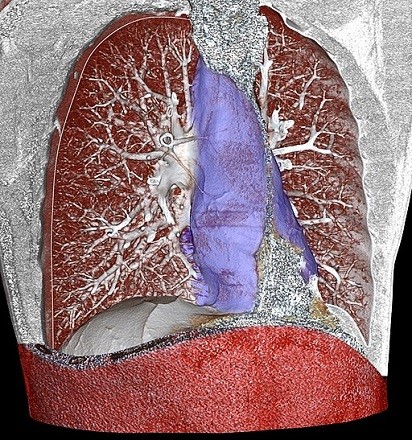
© By Mikael Häggström (Own work), via Wikimedia Commons
The mediastinum also contains lymph nodes and the thymus. Both of these are part of the immune system and help in fighting infection.
Mediastinoscopy is a type of 'keyhole' surgery where only very small cuts (incisions) are made to the body. It uses a special instrument called a mediastinoscope. This is a thin, tube-like instrument which has a camera built into the end. The 'scope' is inserted into a small incision in the upper chest. This is then linked up to a monitor, allowing the surgeon to see pictures of the chest.
While looking at these pictures, the surgeon may see something which they feel needs investigating further. Using the mediastinoscope they can take very small samples from within the chest. These can then be looked at further under a microscope.
What is mediastinoscopy used for?
The most common reason for mediastinoscopy is as a staging procedure in the diagnosis of non-small cell lung carcinoma. The results obtained from the procedure are very important in tailoring care for the patient.
Other indications for mediastinoscopy include:
The diagnosis and removal of mediastinal masses and enlarged lymph nodes.
Lymphoma, both Hodgkins and non-Hodgkins, can be diagnosed via mediastinoscopy along with सारकॉइडोसिस which has similar appearances on imaging.
A mediastinal mass, such as a thymoma, may be removed using mediastinoscopy, depending on its size.
A sampling of lymph nodes may diagnose infectious processes such as तपेदिक और fungal infections.
Benign (non-cancerous) mediastinal cysts can be taken out using mediastinoscopy.
Mediastinoscopy is used in the diagnosis and treatment of mesothelioma.
How does mediastinoscopy work?
Before the operation, a small needle will be placed into a vein (usually on the back of the hand) to give you fluids and medication.
Mediastinoscopy is generally done under general anaesthetic, meaning that you will be asleep for the procedure. After you are asleep, a tube (an endotracheal tube - also called an ET tube) will be placed in your throat to help you breathe during the procedure. Your neck and chest will be washed with an antiseptic soap and covered with a sterile drape.
The surgeon may make two or three small cuts (incisions) in the chest wall above the breastbone (sternum). These holes are known as 'ports' and are usually about an inch long. The mediastinoscope is inserted through one hole. The camera in the mediastinoscope feeds video images to a computer screen, allowing the surgeon to see inside the chest.
Your doctor will also insert special surgical instruments through the other ports. He or she will examine the space in your chest between your lungs and heart. Lymph nodes or abnormal tissue samples will be collected and sent to the laboratory for further tests. After the 'scope' is removed from your chest, all these incisions will be closed with a few stitches and covered with a bandage.The entire procedure usually takes about an hour.
What should I do to prepare for mediastinoscopy?
Your doctor should discuss any specific preparation necessary with you before the procedure. Usually there is not much preparation necessary.
नोट: if you take 'blood-thinning' medicines such as warfarin or aspirin, your doctor may ask you to stop taking these for a few days before your operation.
You will also be asked not to eat or drink for a certain length of time before the procedure. Your local hospital will give you information on this.
What can I expect after mediastinoscopy?
Some people may go home after the procedure if the general anaesthesia wears off and they are able to swallow fluids without gagging or choking. Other people may need to stay in hospital for one or two days. If your stitches are not the dissolving type, you will need to return to your doctor to have them removed.
You may have a slightly sore throat - this is normal and usually due to the tube used to help you breathe during the operation. The sites where the cuts (incisions) were made may be sore for a few days after the procedure.
Are there complications after mediastinoscopy?
Most people who have a mediastinoscopy do not develop any complications.
Sometimes the mediastinoscope can temporarily injure a nerve, which may cause hoarseness. This can occasionally be permanent.
In rare cases, bleeding complications might require a transfusion or larger chest surgery. Air leaks from the lung can also occur and occasionally require additional treatment. Usually this involves putting in a drainage tube between your ribs for a few days.
Rarely mediastinoscopy may cause a collapsed lung (pneumothorax) or damage to the gullet (oesophagus).
You should contact your doctor if you become unwell after a mediastinoscopy. In particular, if you have any of the following problems:
Bleeding from your stitches.
उच्च तापमान (बुखार)।.
Severe chest pain.
Swelling in the neck.
सांस लेने में तकलीफ।.
निगलने में कठिनाई।.
Hoarseness of your voice that lasts more than a few days or continues to worsen.
Advances in X-ray technology and surgical techniques mean that it may be possible to offer you options which cause less discomfort than mediastinoscopy.
रोगी के लिए चयन इमेजिंग

परीक्षण और जांच
मस्तिष्क एंजियोग्राफी
सेरेब्रल एंजियोग्राफी एक परीक्षण है जो एक्स-रे और एक विशेष डाई का उपयोग करके मस्तिष्क को रक्त की आपूर्ति करने वाली रक्त वाहिकाओं की तस्वीरें बनाता है। नोट: नीचे दी गई जानकारी केवल एक सामान्य मार्गदर्शिका है। व्यवस्थाएं और परीक्षण करने के तरीके विभिन्न अस्पतालों में भिन्न हो सकते हैं। हमेशा अपने डॉक्टर या स्थानीय अस्पताल द्वारा दिए गए निर्देशों का पालन करें।.
डॉ. मैरी हार्डिंग, MRCGP द्वारा

परीक्षण और जांच
एक्स-रे परीक्षण
एक्स-रे परीक्षण हड्डियों और कुछ अन्य ऊतकों को दिखाते हैं।.
डॉ. हेले विलासी, FRCGP द्वारा
अक्सर पूछे जाने वाले प्रश्न
What is the mediastinum, and what organs are located in this area?
The mediastinum is a specific area within the chest that contains several vital organs. These include the heart, the gullet (oesophagus), the windpipe (trachea), and various nerves. It also houses lymph nodes and the thymus, both of which are crucial parts of the immune system, helping the body fight infections.
What is the purpose of the 'ports' in a mediastinoscopy procedure?
During a mediastinoscopy, the surgeon makes two or three small incisions, known as 'ports', in the chest wall just above the breastbone. These ports are typically about an inch long. The mediastinoscope, which has a camera, is inserted through one of these holes. Special surgical instruments are then inserted through the other ports, allowing the surgeon to visualise the inside of the chest and collect tissue samples.
How long does a mediastinoscopy procedure typically last?
The entire mediastinoscopy procedure usually takes approximately one hour to complete.
Are there any specific instructions regarding food and drink before the mediastinoscopy?
Yes, you will be asked not to eat or drink for a certain period before the procedure. Your local hospital will provide you with detailed information about these fasting instructions.
What are some of the signs that I should contact my doctor after a mediastinoscopy?
You should contact your doctor if you experience any of the following problems after a mediastinoscopy: bleeding from your stitches, a high temperature (fever), severe chest pain, swelling in the neck, shortness of breath, difficulty swallowing, or hoarseness that lasts more than a few days or worsens.
अधिक पठन और संदर्भ
- McNally PA, Arthur ME; Mediastinoscopy. StatPearls Publishing. 2018.
- Onat S, Ates G, Avci A, et al; The role of mediastinoscopy in the diagnosis of non-lung cancer diseases. Ther Clin Risk Manag. 2017 Jul 27;13:939-943. doi: 10.2147/TCRM.S144393. eCollection 2017.
लेखक के बारे मेंपूरा जीवन परिचय देखें

Dr Laurence Knott
सामान्य चिकित्सक, चिकित्सा लेखक
बीएससी (ऑनर्स) बायोकैमिस्ट्री, एमबीबीएस
डॉ लॉरेंस नॉट ने 1973 में योग्यता प्राप्त की और एक सामान्य चिकित्सक के रूप में व्यापक अनुभव प्राप्त किया है।.
समीक्षक के बारे मेंपूरा जीवन परिचय देखें

Dr Colin Tidy, MRCGP
सामान्य चिकित्सक, चिकित्सा लेखक
MBBS, MRCGP, MRCP (Paediatrics), DCH
डॉ. कॉलिन टिडी एक एनएचएस डॉक्टर हैं, जो ऑक्सफोर्डशायर में स्थित हैं।.
लेख का इतिहास
इस पृष्ठ पर दी गई जानकारी योग्य चिकित्सकों द्वारा लिखी और सहकर्मी समीक्षा की गई है।.
लेख इन भाषाओं में भी उपलब्ध है अंग्रेज़ी, जर्मन, स्पेनिश, फ्रेंच, इतालवी, पुर्तगाली, हिंदी, हिब्रू, अरबी, और स्वीडिश.
17 Feb 2019 | नवीनतम संस्करण

पूछें, साझा करें, जुड़ें।.
चर्चाओं को ब्राउज़ करें, प्रश्न पूछें, और सैकड़ों स्वास्थ्य विषयों पर अनुभव साझा करें।.

अस्वस्थ महसूस कर रहे हैं?
अपने लक्षणों का ऑनलाइन मुफ्त में मूल्यांकन करें
पेशेंट न्यूज़लेटर के लिए साइन अप करें
आपकी साप्ताहिक खुराक स्पष्ट, विश्वसनीय स्वास्थ्य सलाह की - जो आपको सूचित, आत्मविश्वासी और नियंत्रण में महसूस करने में मदद करने के लिए लिखी गई है।.
सदस्यता लेने पर आप हमारी स्वीकार करते हैं गोपनीयता नीति. आप किसी भी समय सदस्यता समाप्त कर सकते हैं। हम कभी भी आपका डेटा नहीं बेचते।.
परीक्षणों और जांचों में अधिक
- रक्त जमावट परीक्षण
- रक्त ग्लूकोज परीक्षण (रक्त शर्करा) और HbA1c
- अस्थि मज्जा बायोप्सी और एस्पिरेशन
- हड्डी का स्कैन
- आंत्र कैंसर की जांच
- स्तन जांच
- हृदय कैथेटराइजेशन
- गर्भाशय ग्रीवा की जांच
- सीटी स्कैन
- सिस्टोस्कोपी
- अनुमानित ग्लोमेरुलर निस्यंदन दर
- व्यायाम सहनशीलता परीक्षण
- किडनी बायोप्सी
- नासोएंडोस्कोपी
- नवजात शिशु शारीरिक परीक्षण
- गर्भावस्था स्क्रीनिंग परीक्षण
- प्रोटीन्यूरिया
- थैलेसीमिया
- थायरॉइड कार्य परीक्षण
- यूरोडायनामिक परीक्षण