मायोपिया
Short-sightedness
द्वारा सहकर्मी समीक्षा की गई Dr Mohammad Sharif Razai, MRCGPद्वारा अंतिम अपडेट Dr Philippa Vincent, MRCGPअंतिम अद्यतन 29 दिसम्बर 2023
मरीज की संपादकीय दिशानिर्देशों
- डाउनलोडडाउनलोड
- साझा करें
- Language
- चर्चा
- Ask Patient
- ऑडियो संस्करण
- Google पर पसंदीदा स्रोतों में जोड़ें
The medical name for short-sightedness is myopia. Eyesight problems, such as myopia, are also known as refractive errors. Short-sightedness leads to blurred vision when looking at things at a distance, whilst close vision is usually normal. Short-sightedness is a very common problem that can be corrected by glasses, contact lenses, or laser eye surgery.
एक नजर में
Myopia, or short-sightedness, means light focuses in front of the retina, making distant objects blurry.
It usually starts in childhood or teenage years and often runs in families.
The main symptom is difficulty seeing things far away clearly.
Glasses, contact lenses, or laser eye surgery can correct myopia.
Regular eye tests are recommended, typically every two years.
If you notice any changes in your vision, you should see an optician.
क्या है myopia (short-sightedness)?
Myopia (also known as short-sightedness or near-sightedness) is a refractive error that occurs when light coming from distant objects is 'overfocused', so that the point of focus is in front of the retina.
It occurs because either the eyeball is too long or, less commonly, because the cornea is too curved. Despite maximum flattening of the lens, the eye is not able to focus the light rays further back and on to the retina.
In myopia, the eye focuses light from near objects more effectively than light from objects further away. This means that short-sighted people can see close objects clearly because the light rays from these objects enter the eyes at an angle and focus correctly on the retina. In contrast, distant objects appear more blurry as their light rays do not focus properly in the eye.
Short-sightedness

The diagram above shows the differences in focusing between a normal and a short-sighted (myopic) eye.
What are the symptoms of myopia (short-sightedness)?
The main symptom is difficulty with seeing things that are far away. The younger short-sightedness starts, the more severe it is likely to become.
By the time early adulthood is reached, the level of myopia has usually reached its peak. This means that the vision does not generally become any worse after the age of mid to late twenties.
Some children do not realise that their vision is not as good as it should be. They may be able to read books and do close work well. However, seeing distant objects such as the board at school may become difficult. They may think this is normal and not tell anyone. A child's teacher may notice that children are having difficulties reading the board in class. Schoolwork may suffer for a while before the condition is identified and treatment provided.
Children usually have a routine preschool or school-entry vision check but if there is any suspicion that a child has problems with his or her sight, an appointment should be booked with an optician. Even very young children can have eye tests at most high street opticians.
What causes myopia (short-sightedness)?
Short-sightedness tends to start in childhood and early teenage years.
It is likely to result from a combination of genes and lifestyle factors (such as spending long periods of time doing close-up work or indoors). It often runs in families.
Temporary short-sightedness can also occur with certain illnesses - for example, in मधुमेह.
अपवर्तक त्रुटि क्या है?
A refractive error is an eyesight problem. Refractive errors are the most common reason worldwide for reduced levels of eyesight (visual acuity).
आंख का क्रॉस-सेक्शन
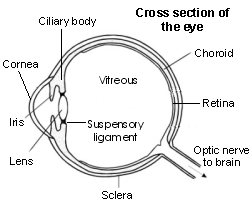
Refraction refers to the bending of light, in this case by the eye, in order to focus it. A refractive error means that the eye cannot focus light on to the retina properly.
This usually occurs either due to abnormalities in the shape of the eyeball, or because age has affected the workings of the parts of the eye that have the job of focusing light.
There are four types of refractive error:
Myopia (short-sightedness).
अपवर्तक त्रुटियों को पूरी तरह से समझने के लिए, यह जानना उपयोगी है कि हम कैसे देखते हैं।.
जब हम किसी वस्तु को देखते हैं, तो उस वस्तु से प्रकाश किरणें आंख के माध्यम से रेटिना तक पहुंचती हैं। इससे रेटिना की कोशिकाओं से ऑप्टिक तंत्रिका के माध्यम से मस्तिष्क के दृष्टि केंद्रों तक तंत्रिका संदेश भेजे जाते हैं। मस्तिष्क प्राप्त जानकारी को संसाधित करता है, जिसके परिणामस्वरूप एक छवि बनती है जिसे हम देख सकते हैं।.
आँख पर ध्यान केंद्रित करना
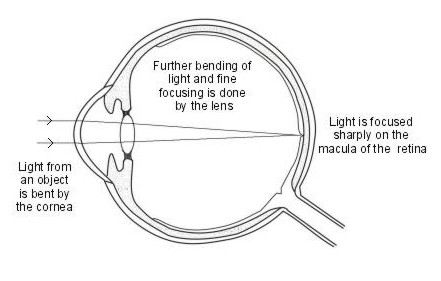
Light rays come off an object in all directions, as they result from light bouncing back off the object. The part of this bounced light that comes into the eye from an object needs to be focused on a small area of the retina. If this doesn't happen, what we look at will be blurred.
The cornea and lens have the job of focusing the light. The cornea does most of the work as it bends (refracts) the light rays which then go through the lens, which finely adjusts the focusing. The lens does this by changing its thickness. This is called accommodation. The lens is elastic and can become flatter or more rounded. The more rounded (convex) the lens, the more the light rays can be bent inwards.
The shape of the lens is varied by small muscles in the ciliary body. Tiny string-like structures called the suspensory ligaments are attached at one end to the lens and at the other to the ciliary body. This is a bit like a trampoline with the central bouncy bit being the lens, the suspensory ligaments being the springs, and the ciliary muscles being the rim around the edge.
जब सिलिअरी शरीर में सिलिअरी मांसपेशियाँ कसती हैं, तो निलंबन लिगामेंट ढीले हो जाते हैं, जिससे लेंस मोटा हो जाता है। यह पास की वस्तुओं के लिए होता है। दूर की वस्तुओं को देखने के लिए, सिलिअरी मांसपेशी आराम करती है, जिससे निलंबन लिगामेंट कस जाते हैं, और लेंस पतला हो जाता है।.
पास की वस्तुओं पर ध्यान केंद्रित करने के लिए प्रकाश किरणों का अधिक मोड़ (अपवर्तन) आवश्यक होता है, जैसे कि पढ़ते समय। दूर की वस्तुओं पर ध्यान केंद्रित करने के लिए प्रकाश का कम मोड़ आवश्यक होता है।.
Complications with myopia (short-sightedness)
The vast majority of people with short-sightedness have no additional problems.
However, people with severe short-sightedness have a slightly increased chance of developing some other eye conditions. These include:
Raised pressure in the eye (ग्लूकोमा).
These are serious eye conditions, so regular eye checks are advisable and new or changing vision symptoms should be reported promptly to an optician.
What is the treatment for myopia (short-sightedness)?
चश्मा
Short-sightedness can be corrected with glasses, which is the simplest, cheapest and safest way.
Concave prescription lenses (called minus lenses) are used to bend light rays slightly outwards to counteract the over-focusing tendency. As a result, the light rays focus further back in the eye on the retina.
कॉन्टैक्ट लेंस
These do the same job as glasses but they sit on the surface of the eye.
Many different types of contact lenses are available. Lenses may be soft or rigid. They can be daily disposable, extended wear, monthly disposable, or non-disposable.
Contact lenses tend to be more expensive than glasses. They provide good all-round vision and do not mist over (for example, while doings sports or in hot environments). They do, however, require more care and meticulous hygiene, and should not usually be worn whilst sleeping.
They are usually more suitable for older teenagers and adults, rather than very young children.
लेज़र आँख की सर्जरी
Laser eye surgery is an option for some people with short-sightedness. Generally, this type of surgery is not available on the NHS and can be expensive. Many private companies advertise laser eye surgery.
Complete and permanent resolution of the refractive error is possible in a number of people. Others have a significant improvement even though perfect vision is not achieved and glasses or contact lenses may still be needed.
Refractive surgery must be carried out in premises registered with the Care Quality Commission (CQC) in England, or the equivalent regulator in Scotland, Wales and Northern Ireland.
Several types of laser surgery have been developed. Three main types are used in the UK: LASIK®, surface laser treatments (PRK®, LASEK® and TransPRK®) and SMILE®.
They are all similar, typically taking about ten minutes per eye and aiming to reshape the cornea by using the laser to remove a very thin layer of corneal tissue. The reshaping of the cornea allows the refraction of the eye to be corrected.
LASIK®
LASIK stands for Laser-जैसेsisted मैंn situ Kएरेटोमिल्यूसिस। यह लेजर आंख सर्जरी का सबसे लोकप्रिय प्रकार है।.
सर्जरी दो लेज़रों के साथ की जाती है; पहला लेज़र कॉर्निया का एक पतला फ्लैप बनाता है, जिसे हटाकर दूसरा लेज़र कॉर्निया को नया आकार देने के लिए उपयोग किया जाता है।.
This reshaping involves flattening the cornea so that light rays coming from an object can be focused further back and on to the retina.
फिर फ्लैप को वापस रखा जाता है, और यह बिना टांके की आवश्यकता के खुद ही नीचे की कॉर्निया से चिपक जाता है। फ्लैप एक प्राकृतिक पट्टी के रूप में कार्य करता है, जिससे आंख को आराम मिलता है और यह जल्दी से ठीक हो जाती है।.
दृष्टि की पुनःप्राप्ति का समय लगभग 24 घंटे कहा जाता है। लोग LASIK सर्जरी के अगले दिन काम पर लौट सकते हैं, लेकिन किसी भी संपर्क खेल को करने से पहले कम से कम एक महीने का इंतजार करना चाहिए।.
Surface laser treatments (PRK®, LASEK® and TransPRK®)
PRK stands for Pफोटो-Refractive Kरेटेक्टॉमी।.
LASEK stands for LAser Sउप-Epithelial Kरेटोमिल्यूसिस।.
इन प्रकार के उपचारों में, कोई फ्लैप नहीं बनाया जाता है, बल्कि इसके बजाय, आँख की सतह पर बहुत पतली कोशिकाओं की परत (एपिथेलियम) को या तो हटा दिया जाता है या विस्थापित कर दिया जाता है, और इसे आकार देने के लिए सीधे कॉर्निया पर लेजर लगाया जाता है। एपिथेलियम स्वाभाविक रूप से फिर से बढ़ेगा, लेकिन जब यह ऐसा कर रहा होता है, तो आँख बहुत दर्दनाक होगी।.
सभी सतह परत उपचार समान परिणाम उत्पन्न करते हैं, और उनके बीच एकमात्र अंतर यह है कि पतली सतह परत (एपिथेलियम) को किस प्रकार से हटाया जाता है। PRK और LASEK में इसे सर्जन द्वारा हटाया जाता है। TransPRK में इसे लेजर द्वारा पुनः आकार देने के उपचार के हिस्से के रूप में किया जा सकता है।.
सतही लेजर उपचारों के बाद दृष्टि की पुनःप्राप्ति की गति LASIK की तुलना में धीमी होती है, और मरीजों को ड्राइविंग मानक तक पहुँचने में एक सप्ताह या उससे अधिक समय लग सकता है। हालांकि, मरीज LASIK के बाद की तुलना में संपर्क खेलों में जल्दी लौट सकते हैं।.
SMILE®
SMILE stands for Smसभी मैंncision Lenticule Extraction.
With the help of a laser, the surgeon cuts and removes a disc-shaped piece of cornea through a small hole created at the surface of the eye. This reshapes and flattens the cornea - a bit like LASIK but without the flap and also with a thicker piece of cornea taken from deeper within the cornea.
Results from SMILE are similar to LASIK and surface laser treatments.
सभी लेजर सर्जरी के दुष्प्रभावों में शामिल हैं:
असुविधा।.
धुंधली दृष्टि।.
रोशनी के चारों ओर चमक और प्रभामंडल (विशेष रूप से रात में)।.
Red marks on the white of the eyes caused by burst small blood vessels (subconjunctival haemorrhages).
These usually get better over time. Over-correction or under-correction of short-sightedness can also happen.
Complications include eye infection and dry eyes. Permanent loss of vision is very rare; if this happens, around 1 in 5,000 people need a corneal transplant to restore their vision. Up to 1 in 10 patients may need additional surgery to get the best result.
Lens surgery
Phakic intraocular lens implantation (PIOL)
Phakic intraocular lenses (PIOLs) are clear, synthetic plastic lenses that are implanted into the eye without removing the eye's own natural lens - a bit like a permanent contact lens.
Depending on which PIOL is used, it either sits in front of, or behind, the pupil. It is inserted into the eye via small cuts on the eye surface that will heal by themselves without the need for stitches.
PIOLs are very effective at correcting both short-sightedness and दृष्टिवैषम्य, can correct a wider range of glasses prescriptions than laser surgery, and may be safer in people who have problems with their cornea or eye surface.
PIOLs tend to be offered to younger people who are not suitable for laser eye surgery.
The operation typically takes about 20 minutes per eye, is performed with eye-drop anaesthetics, and you can go home the same day. The second eye is usually done a day or more after the first eye.
Side-effects include discomfort, blurred vision, glare and haloes around lights (particularly at night), and red patches on the white of the eyes, caused by burst small blood vessels (subconjunctival haemorrhages). These usually get better over time.
Risks include permanent serious loss of vision (which is rare), the earlier development of cataracts, and the need for additional surgery (for example, to reposition the lens). The risks depend on the type of PIOL used and you should seek full information about these from your operating surgeon.
Refractive lens exchange (RLE)
In this procedure, the eye's natural lens is replaced by a clear synthetic implant called an intraocular lens. (IOL). It is essentially the same process as modern cataract surgery.
There are two types of IOL: monofocal IOLs aim to improve distance vision and multifocal IOLs aim to improve distance, intermediate, and close (near) vision.
The old lens is removed and a new lens is inserted via small cuts on the eye surface that will heal by themselves without the need for stitches.
About four out of five patients are completely free of glasses after RLE.
RLE is suitable for people over the age of 50 years who have a prescription that is higher than the normal range for laser eye surgery. RLE can correct almost any level of short-sightedness. It is generally preferred in older people because, as people age, the eye's natural lens becomes less flexible and less clear, so there is more benefit in replacing it. It also eliminates the need to have cataract surgery later in life. However, other treatments may still be suitable in older people with a healthy eye surface and no signs of cataracts.
The operation typically takes about 20 minutes per eye and is performed with eye-drop anaesthetics.
Side-effects include eye discomfort, visual effects (such as blurring of vision, haloes around lights, and shadowing or shimmering arcs around the edges of vision), and subconjunctival haemorrhages. These usually get better over time.
Permanent, serious loss of vision is much more common after RLE than after laser eye surgery or PIOL surgery. It affects approximately 1 in 500 patients. Other risks of the operation include bleeding, infection, and retinal detachment.
After RLE, vision may deteriorate over time due to gradual clouding over of the membrane behind the implanted lens, but this can be corrected with a one-off laser procedure.
अन्य तकनीकें: corneal grafts are options in very severe or specialised cases of myopia.
मुझे कितनी बार दृष्टि परीक्षण की आवश्यकता होती है?
एनएचएस की सिफारिश है कि अधिकांश लोगों को हर दो साल में अपनी दृष्टि की जांच करानी चाहिए। बच्चों को जन्म से लेकर स्कूल की उम्र तक विभिन्न चरणों में नियमित रूप से आंखों की जांच की पेशकश की जाएगी।.
People at higher risk of sight problems need more frequent eyesight checks. An optician will usually recommend more regular check-ups in people with:
A family history of these conditions.
People over the age of 70 years and children who wear glasses may also need more frequent eye tests.
Any changes in vision should be checked by an optician. Some opticians offer a home visiting service to carry out sight tests for people who are permanently housebound.
डॉ मैरी लोथ इस पत्रक की लेखिका या मूल लेखिका हैं।.
रोगी के लिए चयन आंखों की स्थितियां

आंखों का स्वास्थ्य
आंखों में तैरते धब्बे, चमक और प्रभामंडल
आंखों में तैरने वाले धब्बे और चमक सामान्य हैं और आमतौर पर चिंता की कोई बात नहीं होती। ये आमतौर पर आंख के अंदर जेली जैसी पदार्थ (विट्रियस ह्यूमर) में उम्र के साथ होने वाले सामान्य परिवर्तनों के कारण होते हैं। हेलोस प्रकाश के स्रोत के चारों ओर चमकीले घेरे होते हैं। इन्हें चमक भी कहा जाता है। ये एक सामान्य लक्षण हैं, विशेष रूप से वृद्ध लोगों में। कभी-कभी ये ग्लूकोमा जैसी अंतर्निहित आंखों की स्थितियों का संकेत हो सकते हैं।.
डॉ. फिलिपा विंसेंट, MRCGP द्वारा
आंखों का स्वास्थ्य
एपिस्क्लेराइटिस और स्क्लेराइटिस
एपिस्क्लेराइटिस और स्क्लेराइटिस आंख को प्रभावित करने वाली सूजन संबंधी स्थितियां हैं। दोनों लालिमा का कारण बनते हैं, लेकिन स्क्लेराइटिस एपिस्क्लेराइटिस की तुलना में अधिक गंभीर (और दुर्लभ) है।.
डॉ डग मैककेचनी, MRCGP द्वारा
अक्सर पूछे जाने वाले प्रश्न
At what age does short-sightedness typically stop worsening?
The level of short-sightedness usually reaches its peak by the time early adulthood is reached. This means vision generally doesn't get worse after the age of mid to late twenties.
What is the recovery time for different types of laser eye surgery?
For LASIK, vision recovery is often around 24 hours. For surface laser treatments like PRK, LASEK, and TransPRK, visual recovery is slower, and it may take a week or longer to reach the driving standard. Information on SMILE does not specify a recovery time, but mentions results are similar to LASIK and surface treatments.
Can I return to contact sports after laser eye surgery?
After LASIK surgery, you need to wait for at least one month before doing any contact sports. Patients can return to contact sports sooner after surface laser treatments (PRK, LASEK, TransPRK) than after LASIK.
What are Phakic intraocular lenses (PIOLs) and who are they suitable for?
PIOLs are clear, synthetic plastic lenses implanted into the eye without removing the natural lens, acting like a permanent contact lens. They are very effective for correcting both short-sightedness and astigmatism and can handle a wider range of prescriptions than laser surgery. PIOLs are typically offered to younger people who are not suitable for laser eye surgery, or those with corneal or eye surface problems.
What is Refractive Lens Exchange (RLE) and when is it recommended?
RLE is a procedure where the eye's natural lens is replaced with a synthetic intraocular lens, similar to cataract surgery. It is suitable for people over 50 with a prescription too high for laser eye surgery. RLE can correct almost any level of short-sightedness and is preferred in older people because their natural lens may already be less flexible and clear, eliminating the need for cataract surgery later.
अधिक पठन और संदर्भ
- Corneal implants for the correction of refractive error; NICE Interventional Procedure Guidance, July 2007
- अपवर्तक सर्जरी के लिए व्यावसायिक मानक; रॉयल कॉलेज ऑफ़ ऑप्थैल्मोलॉजिस्ट्स (दिसंबर 2021)
- मायोपिया; Nature reviews disease primers
- The Complications of Myopia: A Review and Meta-Analysis; Investigative Ophthalmology and visual Science - an ARVO Journal
- Li SM, Kang MT, Wang NL, et al; Wavefront excimer laser refractive surgery for adults with refractive errors. Cochrane Database Syst Rev. 2020 Dec 18;12(12):CD012687. doi: 10.1002/14651858.CD012687.pub2.
- What Is Small Incision Lenticule Extraction?; American Academy of Ophthalmology (AAO)
- लेजर दृष्टि सुधार; रॉयल कॉलेज ऑफ़ ऑप्थैल्मोलॉजिस्ट्स रोगी सूचना पत्रक
- Phakic Intraocular Lens Implantation; रॉयल कॉलेज ऑफ़ ऑप्थैल्मोलॉजिस्ट्स रोगी सूचना पत्रक
- Refractive Lens Exchange; रॉयल कॉलेज ऑफ़ ऑप्थैल्मोलॉजिस्ट्स रोगी सूचना पत्रक
- Moshirfar M, Bennett P, Ronquillo Y; Laser In Situ Keratomileusis (LASIK).
लेखक के बारे मेंपूरा जीवन परिचय देखें
अपडेट किया

Dr Philippa Vincent, MRCGP
सामान्य चिकित्सक, चिकित्सा लेखक
MB BS, Bsc, MRCGP (2000), DCH, DFSRH, DRCOG
डॉ Philippa विन्सेंट उत्तरी लंदन में एनएचएस जीपी के रूप में काम कर रहे हैं।.
समीक्षक के बारे मेंपूरा जीवन परिचय देखें
Dr Mohammad Sharif Razai, MRCGP
सामान्य चिकित्सक। चिकित्सा लेखक
BSc, BA, MBBChir, MA (Cantab), MRCGP (2021), FHEA, MA (Distn)
डॉ मोहम्मद शरीफ रज़ाई एक पुरस्कार विजेता अंतःविषय वैज्ञानिक, चिकित्सक और शिक्षक हैं। उन्होंने कैम्ब्रिज विश्वविद्यालय से एमए और बैचलर ऑफ मेडिसिन एंड सर्जरी, यूनिवर्सिटी कॉलेज लंदन से बीएससी और बिर्कबेक यूनिवर्सिटी ऑफ लंदन से एमए किया है।.
लेख का इतिहास
लेख इन भाषाओं में भी उपलब्ध है अंग्रेज़ी, जर्मन, स्पेनिश, फ्रेंच, इतालवी, पुर्तगाली, हिंदी, हिब्रू, अरबी, और स्वीडिश.
अगली समीक्षा की तिथि: 27 दिसम्बर 2028
29 दिसम्बर 2023 | नवीनतम संस्करण
द्वारा अंतिम अपडेट
Dr Philippa Vincent, MRCGPद्वारा सहकर्मी समीक्षा की गई
Dr Mohammad Sharif Razai, MRCGP
हमारे में दूसरों के साथ अपने विचार या अनुभव साझा करें रोगी समुदायों.
ऑनलाइन विश्वसनीय उपचार और स्वास्थ्य सेवाओं तक सरल पहुंच।.
Common conditions
Get help with common conditions through the NHS, without a GP appointment.





पेशेंट न्यूज़लेटर के लिए साइन अप करें
आपकी साप्ताहिक खुराक स्पष्ट, विश्वसनीय स्वास्थ्य सलाह की - जो आपको सूचित, आत्मविश्वासी और नियंत्रण में महसूस करने में मदद करने के लिए लिखी गई है।.
सदस्यता लेने पर आप हमारी स्वीकार करते हैं गोपनीयता नीति. आप किसी भी समय सदस्यता समाप्त कर सकते हैं। हम कभी भी आपका डेटा नहीं बेचते।.