एक्स-रे परीक्षण
द्वारा सहकर्मी समीक्षा की गई Dr Colin Tidy, MRCGPद्वारा अंतिम अपडेट Dr Hayley Willacy, FRCGP अंतिम अद्यतन 21 अगस्त 2023
मरीज की संपादकीय दिशानिर्देशों
- डाउनलोडडाउनलोड
- साझा करें
- Language
- चर्चा
- ऑडियो संस्करण
- Google पर पसंदीदा स्रोतों में जोड़ें
एक्स-रे परीक्षण हड्डियों और कुछ अन्य ऊतकों को दिखाते हैं।.
एक नजर में
X-rays are high-energy radiation used to create images of the inside of the body.
Dense tissues like bone appear white, while air-filled areas appear black on an X-ray picture.
X-rays can help diagnose issues with bones, joints, the heart, lungs, and gut.
The test is painless, but you must stay still for a clear picture.
Repeated X-rays carry a small risk of cell damage.
Pregnant women should avoid X-rays due to a small risk to the baby.
A radiologist interprets the X-ray, and a report is sent to your doctor.
What are X-rays?
X-rays are a type of high-energy radiation. An X-ray machine can produce short bursts of X-rays. The rays pass easily through fluids and soft tissues of the body. However, dense tissue such as bone will block some of the X-rays. (Density means how much of something there is in a certain amount of space.) The more dense the tissue, the fewer X-rays pass through. Air and water are less dense because the particles which make them are not held closely together. They let more X-rays pass through them.
What do chest X-rays show?
In an X-ray picture bones show as light/white areas, whereas air shows as black or darker areas. The other lighter area in the middle of the image is the heart. The muscle which makes up the heart is also quite dense and stops X-rays passing through.
Posteroanterior chest X-ray
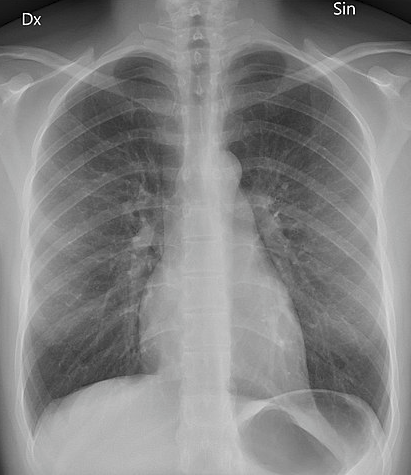
© Mikael Häggström, CC0, via Wikimedia Commons
How is an X-ray test done?
A film, similar to a photographic film, is placed behind the part of the body being X-rayed. The X-ray machine fires a short burst of X-rays through part of your body. The X-rays hit the film, which is then developed. The more X-rays that hit the film, the blacker it develops. So, dense parts of the body that block many of the X-rays show up as white (such as bones). Hollow or air-filled parts of the body show up as black (such as parts of the lung). Soft tissues (such as muscle and body organs) show up as various shades of grey, depending on how dense they are.
The developed film is studied by an X-ray doctor (radiologist) who sends a report to the doctor who requested the test.
An ordinary X-ray test is painless. You cannot see or feel X-rays. You should stay still when the X-ray beam is 'fired', as otherwise the picture may be blurred.
What can an X-ray diagnose?
हड्डियाँ
Bones, teeth, bone fractures and other abnormalities of bone.
Joint spaces and some abnormalities of joints, such as osteoarthritis.
Chest
The size and shape of the heart. So, certain heart conditions can be detected.
Changes in the density of some softer tissues. For example, a lung tumour is more dense than air-filled lung and will show as a 'shadow' on a chest X-ray. A breast tumour (breast cancer) is more dense than ordinary breast tissue and shows as a 'shadow' on an X-ray of the breast. An X-ray of the breast is also known as a मैमोग्राम.
Lung infections (such as निमोनिया या तपेदिक) can be diagnosed with a chest x-ray.
Collections of fluid - for example, in the lung or gut - may show as grey 'shadows' against the normal black of the air-filled chest, or hollow gut.
मस्तिष्क
Blocked blood vessels - a contrast agent that contains iodine can help make areas of your circulatory system (blood vessels) visible on X-rays. A blocked blood vessel in the brain occurs in a स्ट्रोक. This type of x-ray is called an angiogram.
Abdomen
Digestive tract problems (such as difficulty swallowing), are investigated by a barium swallow. A drink containing a contrast agent called barium, is swallowed and this shows up the outline of the gullet. Most blockages can be highlighted this way.
Accidentally swallowed items - metal, glass and stone objects show up quite well on plain x-rays. They will show the doctors where the object is and allow planning of how best to remove it. Other items (such as those made of wood, or plastic) may be seen best using other methods of imaging such as अल्ट्रासाउंड या सीटी स्कैनिंग.
Types of X-rays
An ordinary (often called 'plain') X-ray is a quick, easy and relatively cheap test. It may be all that is needed to diagnose or assess various problems. However, an ordinary X-ray has limited uses.
More specialised types of x-rays include:
Contrast studies: substances are used to highlight certain structures in the x-rays. Common examples are blood vessels (angiograms), different parts of the gut (barium swallows and enemas), and urinary system including the bladder and kidneys, (urograms).
Mammograms: these are special x-rays of the breasts designed to show possible cancerous areas. They are used in breast screening programmes.
CT (computerised tomography); a series of x-ray pictures from different angles which a computer puts togther to give a detailed whole picture.
DEXA (dual energy x-rays absorptiometry); a low dose of x-rays which is designed to measure bone density. This is useful when diagnosing ऑस्टियोपोरोसिस.
How do I get an X-ray?
Your GP or consultant may order an X-ray to help diagnose a medical problem you have been discussing with them. X-rays are usually taken in your local hospital department, although some larger health centres also now take certain simple X-rays.
A report on the X-ray is sent to the doctor who ordered the test. The report will come from a specialist in X-rays and their interpretation - a radiologist. The pictures obtained from the X-ray are not usually seen by the requesting doctor, unless it is an emergency situation such as in an A&E department.
How long do X-ray results take?
X-ray pictures are looked at by a specialist called a radiologist, who sends a report to the requesting doctor. This should be available to that doctor within 1-2 weeks.
If there is a serious or urgent finding the report is sent as soon as possible.
Are X-rays dangerous?
There is very little risk with having one X-ray test. However, with repeated tests there is a risk that the X-rays may damage some cells in the body, possibly leading to cancer in the future. The amount of radiation is always kept to the minimum needed to obtain a good picture of the particular body part being checked. (Also, radiographers who take the X-ray pictures always wear lead aprons or go behind a protective screen when the X-rays are fired, to avoid repeated radiation exposure to X-rays.)
Can you have an X-ray while pregnant?
If possible, pregnant women should not have an X-ray test, as there is a small risk that X-rays may cause an abnormality to the unborn child. This is why women are asked if they are, or might be, pregnant, before having an X-ray.
रोगी के लिए चयन इमेजिंग

परीक्षण और जांच
Dएमएसए स्कैन
एक DMSA स्कैन रेडियोधर्मी रासायनिक का उपयोग करके गुर्दों की विशेष चित्र बनाता है। यह दिखाने में मदद कर सकता है कि गुर्दे क्षतिग्रस्त हैं या दागदार हैं। नोट: नीचे दी गई जानकारी केवल एक सामान्य मार्गदर्शिका है। व्यवस्थाएं और परीक्षण करने के तरीके विभिन्न अस्पतालों में भिन्न हो सकते हैं। हमेशा अपने डॉक्टर या स्थानीय अस्पताल द्वारा दिए गए निर्देशों का पालन करें।.
डॉ डग मैककेचनी, MRCGP द्वारा

परीक्षण और जांच
एमआरसीपी स्कैन
एमआरसीपी स्कैन एक स्कैन है जो आपके यकृत, पित्त नलिकाओं, पित्ताशय और अग्न्याशय की तस्वीरें बनाने के लिए चुंबकीय अनुनाद इमेजिंग का उपयोग करता है। नोट: नीचे दी गई जानकारी केवल एक सामान्य मार्गदर्शिका है। व्यवस्थाएं, और परीक्षण किए जाने का तरीका, विभिन्न अस्पतालों के बीच भिन्न हो सकते हैं। हमेशा अपने डॉक्टर या स्थानीय अस्पताल द्वारा दिए गए निर्देशों का पालन करें।.
डॉ. सुरंगी मेंडिस, एमआरसीजीपी द्वारा
अक्सर पूछे जाने वाले प्रश्न
What is the typical time frame for receiving my X-ray results?
A specialist called a radiologist will examine your X-ray pictures and send a report to your doctor. This report should typically be available to your doctor within one to two weeks.
Why would my doctor order an X-ray instead of another type of scan?
An ordinary or 'plain' X-ray is a quick, easy, and relatively inexpensive test that can often provide enough information to diagnose or assess a variety of problems. While it has limitations, it can be a suitable first step in many situations.
What is the role of a radiologist in the X-ray process?
A radiologist is an X-ray doctor who specialises in studying and interpreting the developed X-ray film. They then send a report with their findings to the doctor who originally requested the test.
How are images from an X-ray different from other types of scans?
In an X-ray, dense tissues like bones appear as light or white areas, while air shows up as black. Soft tissues show up in various shades of grey. This contrast helps identify issues based on density differences within the body.
If I have an X-ray, will I be able to see the pictures myself?
The X-ray pictures are usually not seen by the doctor who requested the test, unless it is an emergency situation, such as in an A&E department. The radiologist analyses them and sends a report to your doctor.
अधिक पठन और संदर्भ
- Tafti D, Maani CV; X-ray Production.
- Frane N, Bitterman A; Radiation Safety and Protection.
लेखक के बारे मेंपूरा जीवन परिचय देखें

Dr Hayley Willacy, FRCGP
सामान्य चिकित्सक, चिकित्सा लेखक
MBChB (1992), DRCOG, DFFP, MRCOG (Part 1) MRCGP (2007), DFSRH (2013), MSc - medical education (2020)
डॉ हेले विलासी एक एनएचएस जीपी थीं जो उत्तर पश्चिम इंग्लैंड में काम कर रही थीं, जिन्होंने 30 वर्षों के बाद 2022 में नैदानिक अभ्यास से सेवानिवृत्ति ली।.
समीक्षक के बारे मेंपूरा जीवन परिचय देखें

Dr Colin Tidy, MRCGP
सामान्य चिकित्सक, चिकित्सा लेखक
MBBS, MRCGP, MRCP (Paediatrics), DCH
डॉ. कॉलिन टिडी एक एनएचएस डॉक्टर हैं, जो ऑक्सफोर्डशायर में स्थित हैं।.
लेख का इतिहास
इस पृष्ठ पर दी गई जानकारी योग्य चिकित्सकों द्वारा लिखी और सहकर्मी समीक्षा की गई है।.
लेख इन भाषाओं में भी उपलब्ध है अंग्रेज़ी, जर्मन, स्पेनिश, फ्रेंच, इतालवी, पुर्तगाली, हिंदी, हिब्रू, अरबी, और स्वीडिश.
अगली समीक्षा की तिथि: 19 अगस्त 2028
21 अगस्त 2023 | नवीनतम संस्करण

पूछें, साझा करें, जुड़ें।.
चर्चाओं को ब्राउज़ करें, प्रश्न पूछें, और सैकड़ों स्वास्थ्य विषयों पर अनुभव साझा करें।.

अस्वस्थ महसूस कर रहे हैं?
अपने लक्षणों का ऑनलाइन मुफ्त में मूल्यांकन करें
पेशेंट न्यूज़लेटर के लिए साइन अप करें
आपकी साप्ताहिक खुराक स्पष्ट, विश्वसनीय स्वास्थ्य सलाह की - जो आपको सूचित, आत्मविश्वासी और नियंत्रण में महसूस करने में मदद करने के लिए लिखी गई है।.
सदस्यता लेने पर आप हमारी स्वीकार करते हैं गोपनीयता नीति. आप किसी भी समय सदस्यता समाप्त कर सकते हैं। हम कभी भी आपका डेटा नहीं बेचते।.
परीक्षणों और जांचों में अधिक
- श्रवण विज्ञान
- Barium tests
- रक्त ग्लूकोज परीक्षण (रक्त शर्करा) और HbA1c
- बीआरसीए जीन
- स्तन जांच
- हृदय कैथेटराइजेशन
- मस्तिष्क एंजियोग्राफी
- गर्भाशय ग्रीवा की जांच
- कोरोनरी एंजियोग्राफी
- एंडोस्कोपिक अल्ट्रासाउंड स्कैन
- व्यायाम सहनशीलता परीक्षण
- गैस्ट्रोस्कोपी
- नवजात श्रवण परीक्षण
- नवजात स्क्रीनिंग परीक्षण
- त्वचा चुभन एलर्जी परीक्षण
- लक्षण परीक्षक
- साइनैक्थेन परीक्षण
- थायरॉइड कार्य परीक्षण
- अल्ट्रासाउंड स्कैन
- मूत्र डिपस्टिक परीक्षण