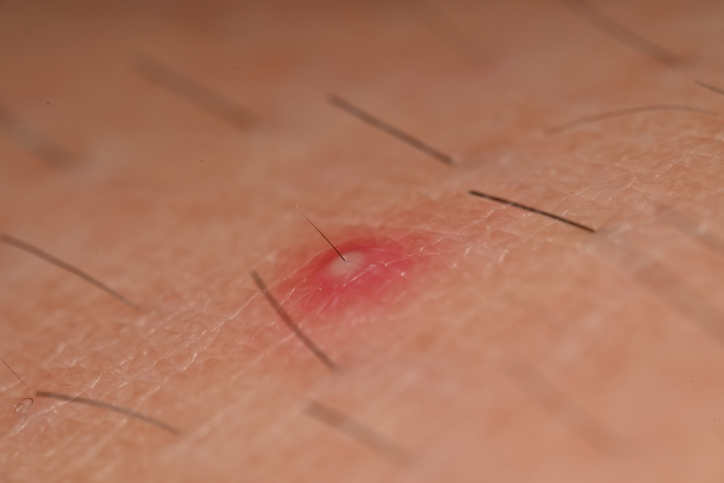
फॉलिकुलाइटिस
द्वारा सहकर्मी समीक्षा की गई Dr Doug McKechnie, MRCGPद्वारा अंतिम अपडेट Dr Philippa Vincent, MRCGPअंतिम अद्यतन 15 सितम्बर 2024
मरीज की संपादकीय दिशानिर्देशों
- डाउनलोडडाउनलोड
- साझा करें
- Language
- चर्चा
- Ask Patient
- ऑडियो संस्करण
- Google पर पसंदीदा स्रोतों में जोड़ें
इस श्रृंखला में:त्वचा पर चकत्तेसेल्युलाइटिसErythema toxicum neonatorumपेरिओरल डर्मेटाइटिसरोजेशियाखुजली
Folliculitis means inflammation of the hair follicles of the skin. Most of the skin is covered with tiny hairs which grow out of hair follicles. In folliculitis, many hair follicles in one area of the skin are affected.
एक नजर में
फॉलिकुलाइटिस बालों के रोमछिद्रों की दर्द और सूजन है।.
संक्रमित रोम सूज सकते हैं, जिससे लाल धब्बे या मवाद से भरे धब्बे बन सकते हैं जो पपड़ी बन सकते हैं।.
यह आमतौर पर नितंबों, पैरों, पीठ, छाती, चेहरे और खोपड़ी पर दिखाई देता है।.
अधिकांश मामले हल्के होते हैं और 7-10 दिनों के भीतर बिना उपचार के ठीक हो जाते हैं।.
यदि सरल उपाय मदद नहीं करते हैं या संक्रमण गहराई तक फैलता है, तो चिकित्सा सलाह लें।.
What is folliculitis?
Folliculitis means inflammation of the hair follicles. Folliculitis can be a mild, short-lived condition or a severe long-term problem. Folliculitis can occur anywhere on hair-bearing skin. There are a number of causes of inflammation which can result in folliculitis.
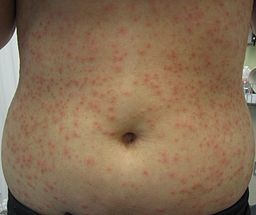
Rash of folliculitis
Folliculitis symptoms
When hair follicles become infected or inflamed they swell causing a red bump on the skin.
Sometimes the affected follicles fill with pus, covering the affected skin with small, rounded, yellow-red spots (pustules).
Affected skin may develop a crust, which can be yellow or golden coloured due to infection.
The affected skin can feel painful, hot and may be itchy.
Folliculitis locations
Folliculitis can be found everywhere where hair grows but the following areas are particularly common:
Buttocks.
Legs.
Back.
Chest.
Face.
Scalp.
Types of folliculitis
बैक्टीरियल फॉलिकुलाइटिस
This is the commonest type of folliculitis and usually arises from the typical bacteria which normally live on the skin causing an infection in the hair follicles. It is very common and easily treated with antibiotics if it is significant enough to need treatment. Often it will settle on its own without treatment.
There are a few specific types of folliculitis:
Sycosis barbae
This is the medical name for a long-term (chronic) folliculitis in the beard area of the face. The skin is painful and crusted, with burning and itching on shaving. Numerous pustules develop in the hair follicles. It can be difficult to treat and some men grow a beard to solve the problem.
Hot tub folliculitis
As the name suggests, this tends to affect people after using a hot tub. The hot water encourages a bacteria called Pseudomonas aeruginosa to grow (particularly if there is not enough chlorine in the water to keep it clean). This type of folliculitis is generally harmless and is prevented by proper maintenance of hot tubs. Showering after using the hot tub does not seem to reduce the chance of folliculitis. Antibiotics are not needed for hot tub folliculitis; it usually settles within 2 weeks.
Gram-negative folliculitis
This is a type of folliculitis that may occur after acne has been treated with long-term antibiotics. Gram-negative refers to a type of stain that is used in a laboratory to identify different types of bacteria.
Pseudo-folliculitis
Also known as "razor bumps", this is caused by inflammation from shaving and ingrowing hairs. Pseudo-folliculitis is more common in people with curly or Afro-Caribbean hair, as these hairs are more likely to curl back and grow into the skin. Ingrowing hairs can also be caused by dead skin cells blocking the hair follicle so the hair cannot exit the follicle.
Malassezia folliculitis
Also known as pityrosporum folliculitis, this is caused by yeasts which normally live on the skin but occasionally cause inflammation. Malassezia folliculitis is more common in adolescent boys and young men and is also more common in hot humid climates. Other things that make malassezia folliculitis more common are frequent use of sunscreen, excessive sweating, antibiotic use and the immune system being impaired.
फॉलिकुलाइटिस
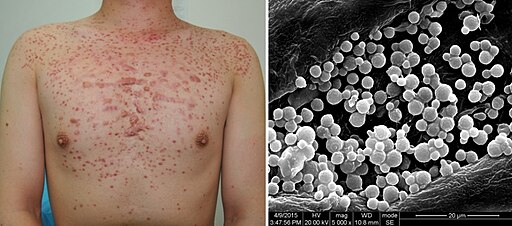
Eosinophilic folliculitis
This rare form of folliculitis is also known as eosinophilic pustular folliculitis or Ofuji disease. It causes itchy pustules and is more common in men than women. The pustules are usually seen on the head, neck and trunk and can persist for weeks or months. It may look like acne. It is associated with HIV but also occurs in people without HIV. Simple anti-inflammatory drugs have been reported to help in up to 7 out of 10 people with eosinophilic folliculitis. Antibiotics may also help.
Carbuncles
A carbuncle is a group of inflamed follicles close together which then join together into one hot red lump with pus coming out of several points. This can be very painful and antibiotics are often needed. Warm compresses may help avoid the need for antibiotics.
Furuncles (boils)
This is an infection deeper in the hair follicle which causes a small abscess just under the skin. It is hot and red. Antibiotics may be needed but warm compresses can often help.
Causes of folliculitis
Folliculitis occurs at sites where hair follicles are inflamed. There are a number of causes:
Infection. Most folliculitis infections are caused by a bacteria called Staphylococcus aureus (S. aureus), which usually lives harmlessly on the skin. Occasionally other bacteria, fungi (Pityrosporum or Candida albicans) or parasites are the cause.
Physical irritation caused by shaving or friction.
Chemical irritation caused by chemicals applied to the skin.
Blockage of the hair follicle eg, by dead skin cells or thick creams.
अत्यधिक पसीना आना (हाइपरहाइड्रोसिस) due to overactivity of the sweat glands.
Steroid creams.
Inflammatory skin conditions are an uncommon cause.
Complications of folliculitis
Most cases of folliculitis get better without any complications. Occasionally the following can occur:
Scarring of the skin.
Darkening of the affected skin (hyperpigmentation).
Hair loss at the affected site due to scarring of the skin.
Deep folliculitis. This occurs if the infection spreads deeper into the follicles causing a boil.
Cellulitis. This is when infection spreads into the surrounding skin, making it hot and red.
Medical advice should be sought if there is an infection which is spreading deeper or onto surrounding skin.
Diagnosing folliculitis
There are no specific tests for folliculitis. Normally the diagnosis is obvious from the type of rash.
Occasionally a swab might help if there is discharge from the pustules.
Folliculitis treatment
Identifying the cause of the folliculitis will help decide what will help. General measures include:
Avoiding things that aggravate the condition.
Taking a break from hair removal until the folliculitis has settled down.
Avoiding wearing tight clothes over the affected area, particularly if it causing sweating.
Keeping cool and keeping folliculitis exposed to the fresh air.
Not sharing towels, flannels or razors.
Applying an antibacterial moisturiser (emollient) and soap substitute. See below for more information.
Mild cases
Most cases of folliculitis are mild and do not need any treatment. It often clears without any treatment within 7-10 days.
It may be helpful to use:
A moisturiser (emollient) which contains an antibacterial agent - for example, Dermol® cream.
Lotion or Emulsiderm®.
These may help the folliculitis to clear more quickly and reduce the risk of it becoming worse. You can use one of these emollients as a soap substitute until the folliculitis has cleared (and long-term if needed). These can also be added to the bath or shower - specific bath or shower products are not needed.
If simple measures over a few days do not result in improvement of the folliculitis, medical advice should be sought for further advice and treatment.
Localised folliculitis
For localised areas of folliculitis, an antibiotic cream may be useful. फ्यूसिडिक एसिड is a suitable antibiotic cream that can be applied 3-4 times per day to affected areas. If the folliculitis is thought to be fungal, a different treatment may be used.
More severe cases
If the folliculitis is more severe or widespread then a course of oral एंटीबायोटिक tablets may be needed.
Recurrent or long-term (chronic) folliculitis
Recurrent folliculitis occurs when the infection keeps coming back, although it disappears with treatment. The gaps between episodes may get shorter and, eventually, chronic folliculitis is the result.
In these cases, a clinician may take a sample (swab) from the skin where the folliculitis is. This swab can show if an infection is responsible and identify which type of infection it is. The correct medication can then be used to try and eradicate the bacteria from the skin.
Preventing folliculitis
To try and prevent folliculitis, the following actions may help:
Keeping skin clean, dry and free from abrasions or irritations.
Keeping skin well-moisturised.
Using clean, sharp razors and shaving in the direction of hair growth, or using an electric razor.
Using a shaving soap, gel or foam to lubricate the blades across the skin to help prevent nicks and cuts.
Using hair removal methods other than shaving.
Avoiding chemicals or items which irritate the skin.
Exfoliating regularly to remove dead skin cells.
Using antiseptic washes routinely is not generally recommended as they can make the skin sore and dry.
Is folliculitis contagious?
Folliculitis itself is not contagious. In hot-tub folliculitis, other people who have been exposed to the same hot tub are likely to develop folliculitis as well.
रोगी के लिए चयन Hair and scalp conditions
त्वचा, नाखून और बालों का स्वास्थ्य
फंगल स्कैल्प संक्रमण
Ringworm is a skin infection caused by a fungus (not a worm). Ringworm on the scalp mainly affects children, particularly of African or Caribbean origin. Treatment is with antifungal medication which is needed for several weeks. An antifungal shampoo is not usually effective alone but may be advised in addition to medication.
डॉ. फिलिपा विंसेंट, MRCGP द्वारा

त्वचा, नाखून और बालों का स्वास्थ्य
पुरुषों में गंजापन
Male pattern baldness is the common type of hair loss that develops in most men at some stage. The medical term for this is androgenetic alopecia. It usually takes 15-25 years to go bald, but can be quicker. Typically, at first the hair begins to thin (recede) at the sides (temples). At the same time, the hair usually becomes thin on the top of the head. A bald patch gradually develops in the middle of the scalp. The receding sides and the bald patch on the top (the crown) gradually enlarge and join together, leaving a patch at the front. The patch at the front eventually thins as well. A rim of hair is often left around the back and sides of the scalp. In some men, this rim of hair also thins and goes, leaving a completely bald scalp.
डॉ. टोनी हैज़ल, FRCGP द्वारा
अक्सर पूछे जाने वाले प्रश्न
क्या फॉलिकुलिटिस मेरे शरीर के एक हिस्से से दूसरे हिस्से में फैल सकता है?
हालांकि स्वयं सूजन व्यक्ति से व्यक्ति में संक्रामक नहीं होती है, यदि फॉलिकुलिटिस संक्रमण के कारण होता है, तो बैक्टीरिया या फंगस आपके शरीर के अन्य बालों के रोमों में फैल सकते हैं, विशेष रूप से यदि आप प्रभावित क्षेत्र को खरोंचते हैं या अत्यधिक पसीने जैसी स्थितियाँ मौजूद हैं।.
क्या फॉलिकुलिटिस आमतौर पर ठीक होने के बाद वापस आ जाता है?
फॉलिकुलाइटिस कभी-कभी उपचार के बाद भी एक बार-बार होने वाली समस्या हो सकती है। यदि अंतर्निहित कारण, जैसे कि कुछ बैक्टीरिया या जलन, पूरी तरह से संबोधित नहीं किया जाता है या फिर से उभरता है, तो फॉलिकुलाइटिस के नए एपिसोड हो सकते हैं। इसे आवर्ती फॉलिकुलाइटिस के रूप में जाना जाता है, जहां संक्रमण बार-बार वापस आता रहता है। कुछ मामलों में, यह एक दीर्घकालिक (क्रोनिक) समस्या भी बन सकता है।.
अगर मुझे फॉलिकुलिटिस है, तो क्या मुझे भविष्य में सार्वजनिक हॉट टब का उपयोग करने से बचना चाहिए?
यदि आपने हॉट टब फॉलिकुलिटिस का अनुभव किया है, तो सार्वजनिक हॉट टब के रखरखाव पर विचार करना एक अच्छा विचार है। इस प्रकार का फॉलिकुलिटिस एक बैक्टीरिया से जुड़ा होता है जो गर्म पानी में पनपता है, खासकर जब पानी को साफ रखने के लिए पर्याप्त क्लोरीन नहीं होता है। आप जिन हॉट टब का उपयोग करते हैं, उनका सही रखरखाव सुनिश्चित करना इसे रोकने की कुंजी है।.
क्या फॉलिकुलिटिस से होने वाली खुजली में मदद करने के लिए कुछ विशेष प्रकार की क्रीम होती हैं?
हालांकि लेख में फॉलिकुलिटिस को साफ करने और इसके बिगड़ने के जोखिम को कम करने के लिए डर्मोल क्रीम जैसे एंटीबैक्टीरियल मॉइस्चराइज़र (इमोलिएंट्स) का उल्लेख किया गया है, लेकिन यह विशेष रूप से खुजली के लिए क्रीम की सिफारिश नहीं करता है। हालांकि, इन इमोलिएंट्स का उपयोग साबुन के विकल्प के रूप में भी किया जा सकता है और ये कुछ राहत प्रदान कर सकते हैं क्योंकि ये त्वचा को शांत करने में मदद करते हैं।.
अधिक पठन और संदर्भ
- फॉलिकुलाइटिस; डर्मनेट NZ
- Folliculitis and boils (furuncles/carbuncles), Primary Care Dermatology Society (PCDS), 2016
- Winters RD, Mitchell M; Folliculitis. StatPearls, September 2019.
- Eosinophilic Pustular Folliculitis; डर्मनेट
लेखक के बारे मेंपूरा जीवन परिचय देखें
अपडेट किया

Dr Philippa Vincent, MRCGP
सामान्य चिकित्सक, चिकित्सा लेखक
MB BS, Bsc, MRCGP (2000), DCH, DFSRH, DRCOG
डॉ Philippa विन्सेंट उत्तरी लंदन में एनएचएस जीपी के रूप में काम कर रहे हैं।.
समीक्षक के बारे मेंपूरा जीवन परिचय देखें

Dr Doug McKechnie, MRCGP
मेडिकल लेखक
MA, MBBS, MSc, DRCOG, MRCP(UK), MRCGP(2021), FHEA
डॉ डग मैककेचनी लंदन में एनएचएस जीपी के रूप में काम कर रहे हैं। वह पूर्णकालिक रूप से क्लिनिकल काम करते हैं और यूनिवर्सिटी कॉलेज लंदन मेडिकल स्कूल में क्लिनिकल और प्रोफेशनल प्रैक्टिस मॉड्यूल के लिए डिप्टी लीड भी हैं।.
हमारे में दूसरों के साथ अपने विचार या अनुभव साझा करें रोगी समुदायों.
ऑनलाइन विश्वसनीय उपचार और स्वास्थ्य सेवाओं तक सरल पहुंच।.
Common conditions
Get help with common conditions through the NHS, without a GP appointment.





पेशेंट न्यूज़लेटर के लिए साइन अप करें
आपकी साप्ताहिक खुराक स्पष्ट, विश्वसनीय स्वास्थ्य सलाह की - जो आपको सूचित, आत्मविश्वासी और नियंत्रण में महसूस करने में मदद करने के लिए लिखी गई है।.
सदस्यता लेने पर आप हमारी स्वीकार करते हैं गोपनीयता नीति. आप किसी भी समय सदस्यता समाप्त कर सकते हैं। हम कभी भी आपका डेटा नहीं बेचते।.