त्वचा पर चकत्ते
द्वारा सहकर्मी समीक्षा की गई Dr Colin Tidy, MRCGPद्वारा अंतिम अपडेट Dr Hayley Willacy, FRCGP अंतिम अद्यतन 14 Feb 2024
मरीज की संपादकीय दिशानिर्देशों
- डाउनलोडडाउनलोड
- साझा करें
- Language
- चर्चा
- Ask Patient
- ऑडियो संस्करण
- Google पर पसंदीदा स्रोतों में जोड़ें
There are many different types of skin rashes and many different causes of skin rashes. Although most skin rashes are harmless, some do need treatment (which may be tablets, creams or ointments) from your doctor or pharmacist.
Some rashes (especially dark red or purple rashes that don't fade when you press them) may even need urgent medical treatment as they can be associated with meningitis and blood infection (septicaemia).
एक नजर में
Skin rashes can be described by their appearance, such as redness or blisters.
Rashes can be flat (macules), raised solid areas (papules, nodules, plaques), or fluid-filled (blisters, pustules).
Some dark red or purple rashes that do not fade with pressure are called purpura.
Common causes of rashes include infections, allergic reactions, and certain medical conditions.
Itchy skin rashes can be caused by dry skin, eczema, or psoriasis.
Seek urgent medical advice if a rash does not disappear quickly, if you feel unwell, or if it does not fade with pressure.
This leaflet is a guide but if you have any concerns, you must seek urgent clinical assessment if:
The rash doesn't quickly disappear.
आप अस्वस्थ महसूस कर रहे हैं।.
The rash does not fade with pressure (the best way to test this is to press a glass gently against the rash to see if it fades).
How are skin rashes described?
Skin rashes can be described in the following way:
Redness of the skin (called erythema).
Flat abnormally coloured areas of skin (called macules). Macules are often either red, dark red or purple, brown or white.
Solid raised areas which are up to half a centimetre across (called papules).
Solid raised areas which are more than half a centimetre across (called nodules).
Areas of red raised skin (called plaques) और scales, which have a flaky silvery-white appearance.
Reddish-purple lesions which do not fade with pressure (called purpura):
If less than one centimetre across then these are called petechiae.
If more than one centimetre across then they are called ecchymoses.
Blisters: these are swellings of the skin containing fluid:
If a blister is less than half a centimetre across then it is called a vesicle. If filled with yellow fluid (pus) then it is called a pustule.
If a blister is larger than half a centimetre across it is called a bulla (plural is bullae).
What skin conditions cause itching?
Skin disorders that can cause itching include (please click the links to separate leaflets which provide further information):
सूखी त्वचा।.
What causes skin rashes?
Please click the links to separate leaflets which provide further information:
Red (erythema) but not scaly skin rash
A skin infection called सेलुलाइटिस.
An allergic reaction called पित्ती.
Reaction to a medicine you are taking.
जलन.
वायरल चकत्ते - eg, खसरा या rubella (German measles).
Vasculitis. This is a condition involving inflammation of blood vessels, which may occur with various illnesses, including रूमेटाइड आर्थराइटिस.
एरिथेमा नोडोसुम. This is a condition which causes red rounded lumps (nodules), most commonly on the shins.
Redness on the palms of your hands may be caused by liver disease, pregnancy or an अत्यधिक सक्रिय थायरॉयड ग्रंथि (हाइपरथायरायडिज्म).
A red rash may occasionally be due to an inflammatory condition called सिस्टेमिक ल्यूपस एरिथेमेटोसस, especially if it is on the cheeks.
Red (erythema) and scaly skin rash
सोरायसिस. This is a condition where there is inflammation of the skin.
एक्जिमा. This is sometimes called dermatitis and also involves inflammation of the skin. It may be caused by an allergy and is then called atopic dermatitis/eczema. This may happen in response to some plants - eg, poison oak or ivy.
सेबोरहाइक डर्मेटाइटिस (in adults). This is a type of skin rash sometimes called seborrhoeic eczema. In babies it is known as cradle cap.
Fungal (or 'yeast') skin infection, such as एथलीट फुट, groin infection (tinea cruris), ringworm, scalp ringworm or infection with कैंडिडा.
पिटीरियासिस रोज़िया. This condition is described as 'self-limiting' and the rash will clear itself naturally.
पिटीरियासिस वर्सिकलर. This is a rash which is caused by a yeast-like germ.
लाइकेन प्लेनस. This condition mainly affects the skin and causes an itchy rash.
Macules
Red macules may be due to a reaction to a medicine or a viral rash - जैसे कि खसरा या रूबेला - as well as other causes.
A brown macule may be a mole but check with your doctor if a mole changes or you are concerned it might be a मेलानोमा.
A white macule may be due to a condition which causes pale patches of skin (called सफेद दाग) or a skin complaint with flaky discoloured areas (called pityriasis versicolor).
If a macule is dark red or purple and does not fade when you put pressure on it then it is a purpura (see below) and you need to see a doctor urgently. This is because it could be a sign of मेनिन्जाइटिस or blood infection (सेप्टीसीमिया).
Papules
Common causes of papules include मुँहासे, viral wart, seborrhoeic wart, मोलस्कम कॉन्टेजियोसम, scabies, insect bites and skin tags.
Other causes include सोरायसिस.
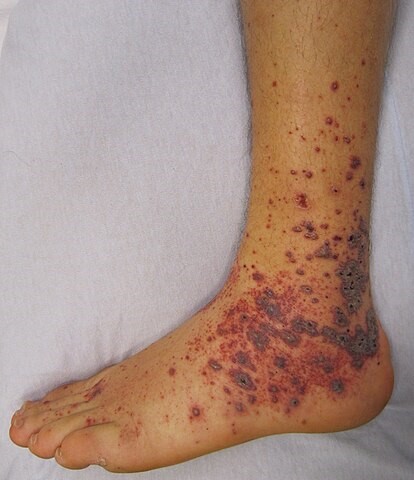
Purpura and petechiae
These are dark red or purple and don't fade when you press them. You need to see a doctor urgently because there may be a serious cause that needs urgent treatment, such as meningococcal infection.
However, common causes include injury to the skin or repeated coughing. More serious common causes include liver disease such as सिरोसिस.
Less common causes include vasculitis (eg, Henoch-Schönlein purpura) or a low level of platelets in your blood (eg, thrombotic thrombocytopenic purpura).
वेस्कुलाइटिस
Nodules
Common causes of a nodule include a sebaceous cyst, lipoma, त्वचा कैंसर, or a wart.
Other causes include rheumatoid nodules (associated with रूमेटाइड आर्थराइटिस) and Heberden's nodes (associated with ऑस्टियोआर्थराइटिस).
Blisters
Skin inflammation, including reactions to medicines, संपर्क त्वचाशोथ, eczema. Eczema on your legs may be caused by varicose veins (varicose eczema).
Diseases of your immune system - eg, bullous pemphigoid.
Viral infections - eg, चिकनपॉक्स, hand, foot and mouth disease.
Skin infection: a germ (bacterial) infection with इम्पेटिगो or viral infection with herpes simplex (ठंडे छाले या जननांग हर्पीस) or with herpes zoster (shingles).
Rarer causes include pemphigus और pemphigoid.
Pustules
Skin infection by a virus (eg, ठंडे छाले due to herpes simplex virus) or bacterial germs (इम्पेटिगो).
Inflammation - eg सोरायसिस.
Pustular skin reaction to medicine you are taking.
Pustules on your face may be acne or rosacea.
अल्सर
Ulcers may be due to venous leg ulcers, pressure ulcers, diabetes skin ulcers या cancerous (malignant) skin ulcers.
This leaflet is a guide but if you have any concerns, you must telephone or see your GP, especially if:
The rash doesn't quickly disappear.
आप अस्वस्थ महसूस कर रहे हैं।.
The rash does not fade with pressure (the best way to test this is to press a glass gently against the rash to see if it fades).
You are not sure what has caused the rash or have any other concerns.
रोगी के लिए चयन त्वचा पर चकत्ते
त्वचा, नाखून और बालों का स्वास्थ्य
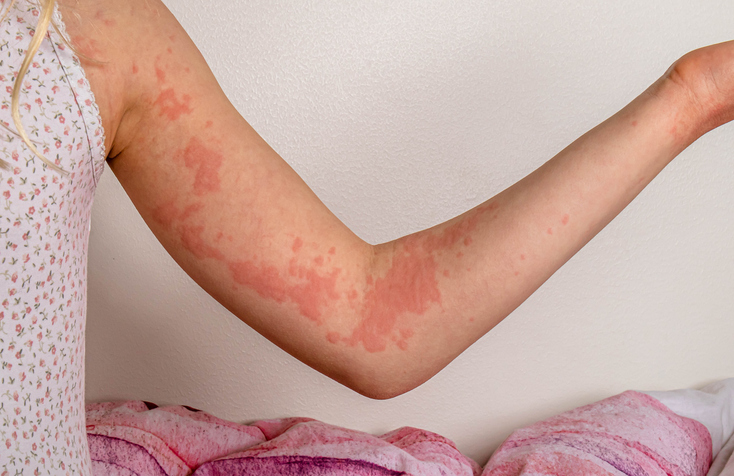
छत्ते
पित्ती (जिसे अर्टिकेरिया भी कहा जाता है) त्वचा पर खुजलीदार लाल या सफेद धब्बे होते हैं जो बिच्छू बूटी के दाने की तरह दिखते हैं। पित्ती आम है और अक्सर एलर्जी प्रतिक्रिया, तनाव, संक्रमण, या कुछ दवाओं के कारण होती है। अधिकांश पित्ती कुछ दिनों के भीतर अपने आप ठीक हो जाती है। यह पत्रक पित्ती के कारणों, प्रकारों और उपचार पर चर्चा करता है।.
डॉ. फिलिपा विंसेंट, MRCGP द्वारा

त्वचा, नाखून और बालों का स्वास्थ्य
बुलस पेम्फिगोइड
Bullous pemphigoid is a skin disease that can cause a rash, itching and blisters. It mainly affects people aged over 70. Treatment usually works well to control symptoms. Treatment is usually with steroid creams or medicines, but sometimes other medicines may be used. The condition tends to go away after 3-6 years and then treatment can be stopped. Sometimes the disease persists.
डॉ कैरोलीन विगिन्स, MRCGP द्वारा
अक्सर पूछे जाने वाले प्रश्न
What is the difference between a macule that is dark red or purple and purpura?
A dark red or purple macule is a flat, abnormally coloured area of skin. If it does not fade when you put pressure on it, it is classified as a purpura. Purpura indicates a potential seriousness, such as meningitis or blood infection, and requires urgent medical attention.
Can rashes on the palms of my hands indicate a serious condition?
Yes, redness appearing on the palms of your hands can be a sign of certain underlying health issues such as liver disease, pregnancy, or an overactive thyroid gland (hyperthyroidism). If you notice this, it is important to consult a doctor.
What is the distinction between a vesicle, a pustule, and a bulla?
These terms all describe blisters, which are swellings of the skin containing fluid. A vesicle is a small blister, less than half a centimetre across. If this small blister is filled with yellow fluid (pus), it is called a pustule. A bulla is a larger blister, more than half a centimetre across.
What specifically is a 'self-limiting' rash like Pityriasis rosea?
A 'self-limiting' rash, such as Pityriasis rosea, means that the rash will clear up on its own naturally without specific medical treatment. It resolves over time without intervention.
Are all brown macules a type of mole?
While a brown macule may be a mole, it's important to be aware that not all brown macules are. You should check with your doctor if a mole changes in appearance or if you have any concerns that it might be a melanoma, which is a type of skin cancer.
When should I be concerned if a macule is dark red or purple?
If a macule is dark red or purple and doesn't fade when pressure is applied, it's called a purpura. In this situation, you need to see a doctor urgently, as it could signal serious conditions like meningitis or a blood infection (septicaemia).
अधिक पठन और संदर्भ
- Meningococcal infection rash images; डर्मनेट NZ
- DermIS - Dermatology Information System
- डायपर रैश; NICE CKS, अक्टूबर 2023 (केवल यूके पहुंच)
लेखक के बारे मेंपूरा जीवन परिचय देखें
अपडेट किया

Dr Hayley Willacy, FRCGP
सामान्य चिकित्सक, चिकित्सा लेखक
MBChB (1992), DRCOG, DFFP, MRCOG (Part 1) MRCGP (2007), DFSRH (2013), MSc - medical education (2020)
डॉ हेले विलासी एक एनएचएस जीपी थीं जो उत्तर पश्चिम इंग्लैंड में काम कर रही थीं, जिन्होंने 30 वर्षों के बाद 2022 में नैदानिक अभ्यास से सेवानिवृत्ति ली।.
समीक्षक के बारे मेंपूरा जीवन परिचय देखें

Dr Colin Tidy, MRCGP
सामान्य चिकित्सक, चिकित्सा लेखक
MBBS, MRCGP, MRCP (Paediatrics), DCH
डॉ. कॉलिन टिडी एक एनएचएस डॉक्टर हैं, जो ऑक्सफोर्डशायर में स्थित हैं।.
चिकित्सा पेशेवर
Looking for more in-depth clinical detail? Our Professional Reference articles are written for doctors, nurses and other healthcare professionals. They include comprehensive clinical guidance, diagnostic information and UK/European evidence summaries. If you need the clinical version, you can read the Professional Reference article on this topic.
हमारे में दूसरों के साथ अपने विचार या अनुभव साझा करें रोगी समुदायों.
ऑनलाइन विश्वसनीय उपचार और स्वास्थ्य सेवाओं तक सरल पहुंच।.
Common conditions
Get help with common conditions through the NHS, without a GP appointment.





पेशेंट न्यूज़लेटर के लिए साइन अप करें
आपकी साप्ताहिक खुराक स्पष्ट, विश्वसनीय स्वास्थ्य सलाह की - जो आपको सूचित, आत्मविश्वासी और नियंत्रण में महसूस करने में मदद करने के लिए लिखी गई है।.
सदस्यता लेने पर आप हमारी स्वीकार करते हैं गोपनीयता नीति. आप किसी भी समय सदस्यता समाप्त कर सकते हैं। हम कभी भी आपका डेटा नहीं बेचते।.